
Industries · Upstream, midstream and downstream operators
one twin from wellhead to terminal
Rotating-equipment failures on compressors and pumps; pipeline integrity; flare and tank events.
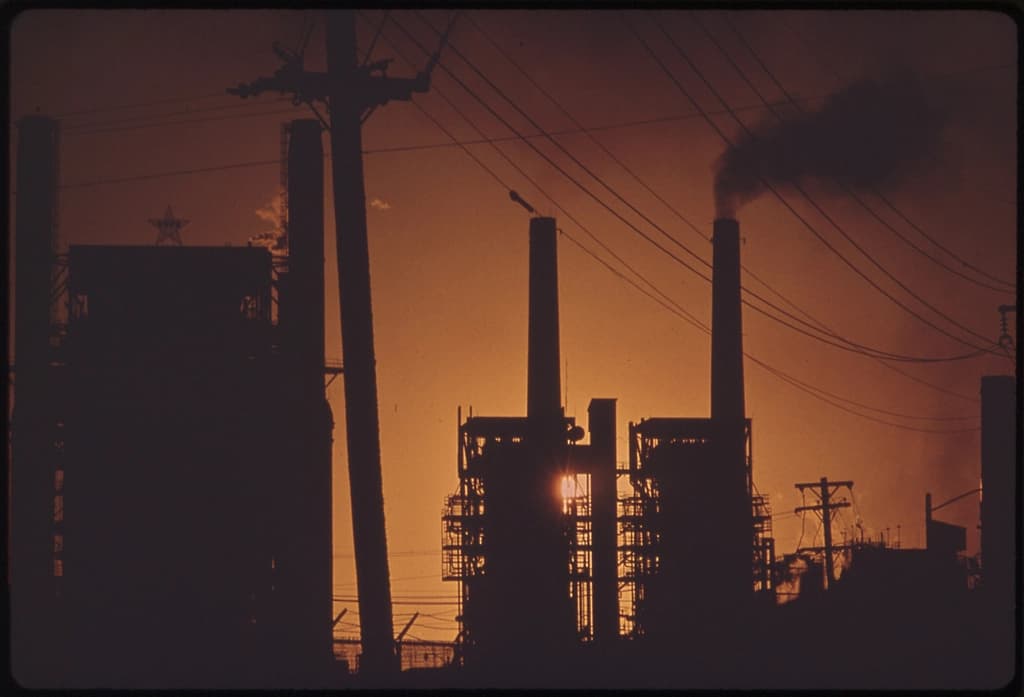
04 · Upstream, midstream and downstream operators
Oil, gas & LNG
Rotating-equipment failures on compressors and pumps; pipeline integrity; flare and tank events.
Modules
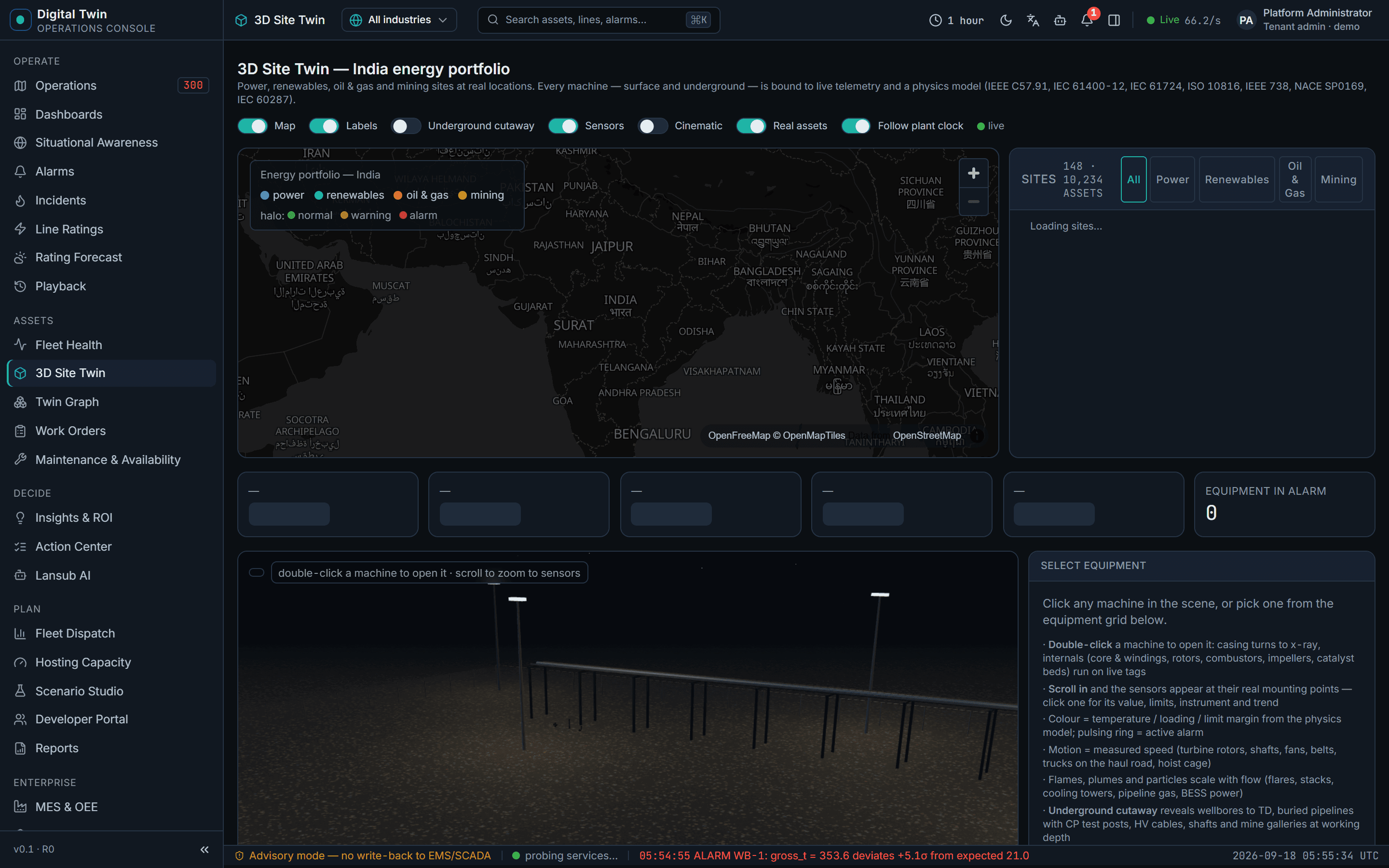
Situational Awareness3D Site TwinFleet HealthAction Center
Equipment classes
CompressorPumpSeparatorPipelineSegmentFurnaceHeatExchangerLNGTankVaporizerFlare
Reference twins
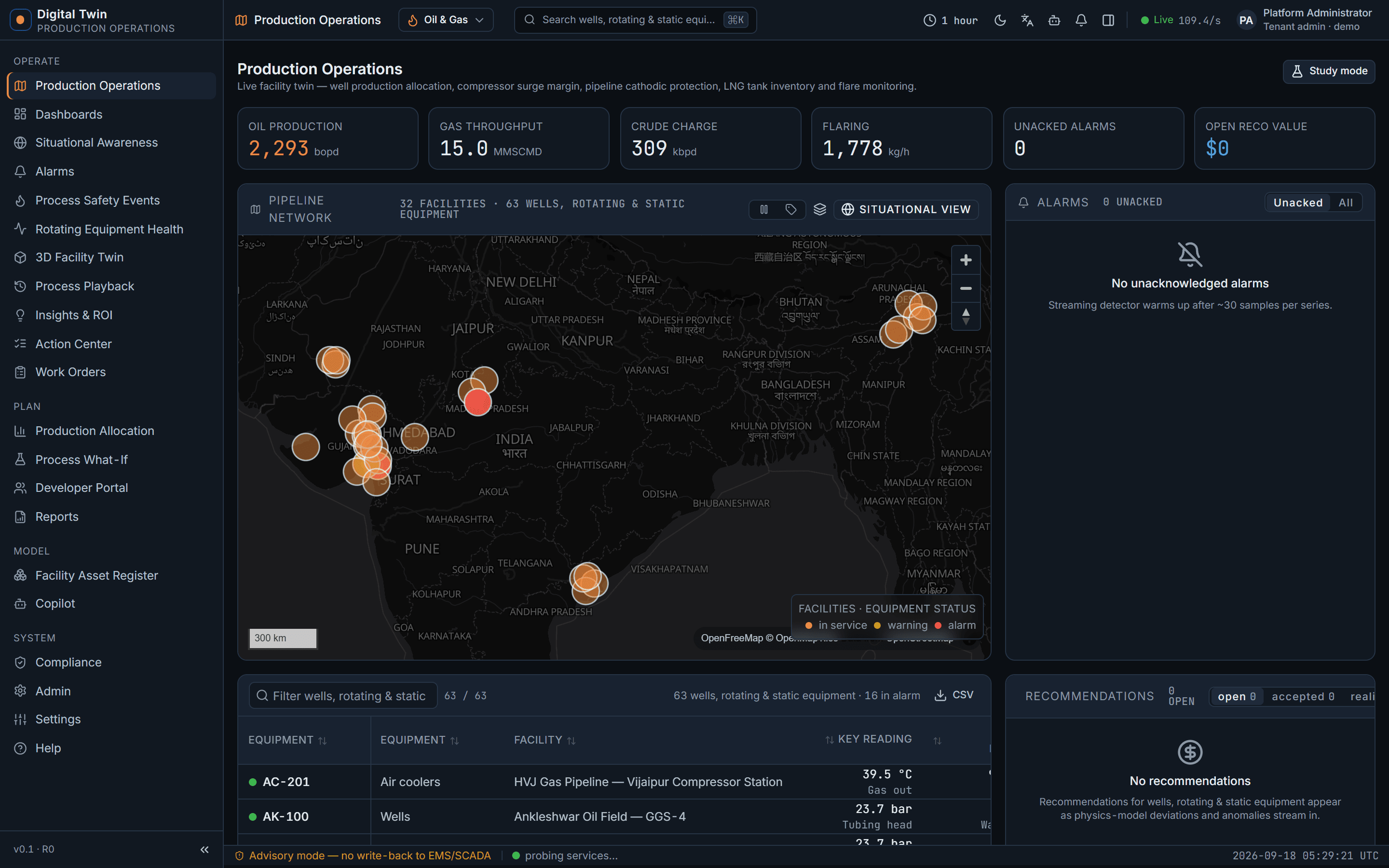
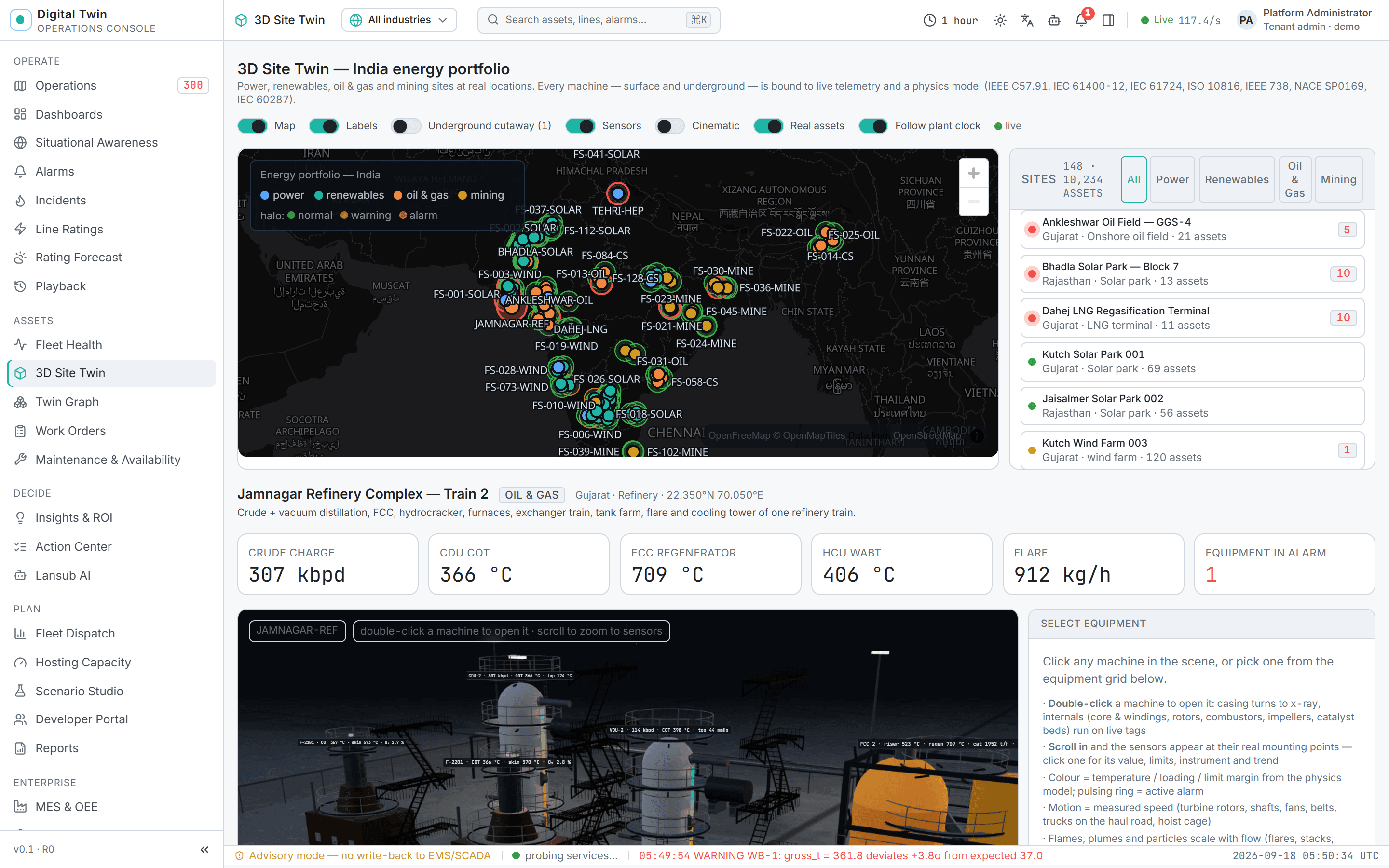
- Ankleshwar Oil Field — GGS-4 · Gujarat5 producers · separator · compressor · flare
- HVJ Gas Pipeline — Vijaipur CS · Madhya Pradesh2 × 13 MW GT compressors · 36" trunk · 12 MMscmd
- Jamnagar Refinery — Train 2 · GujaratCDU · VDU · FCC · hydrocracker · 330 kbpd
- Dahej LNG Terminal · Gujarat2 × 160k m³ tanks · ORV · 17.5 MTPA
Use case · Compressor station health across a 36-inch trunk line
- 1GT-driven centrifugal compressors, pipeline pressure/flow segments and city-gate telemetry stream into the twin.
- 2ISO 10816 vibration severity and process limits drive health indices; the God's Eye view shows the whole corridor.
- 3Recommendations and work orders follow the same dual-control path as the grid — one workflow for every asset class.
Outcome: one operating picture for upstream, midstream and downstream assets with the same audit trail.
Why it pays
What changes for your team
- Compressor and pump health with process context, not just vibration
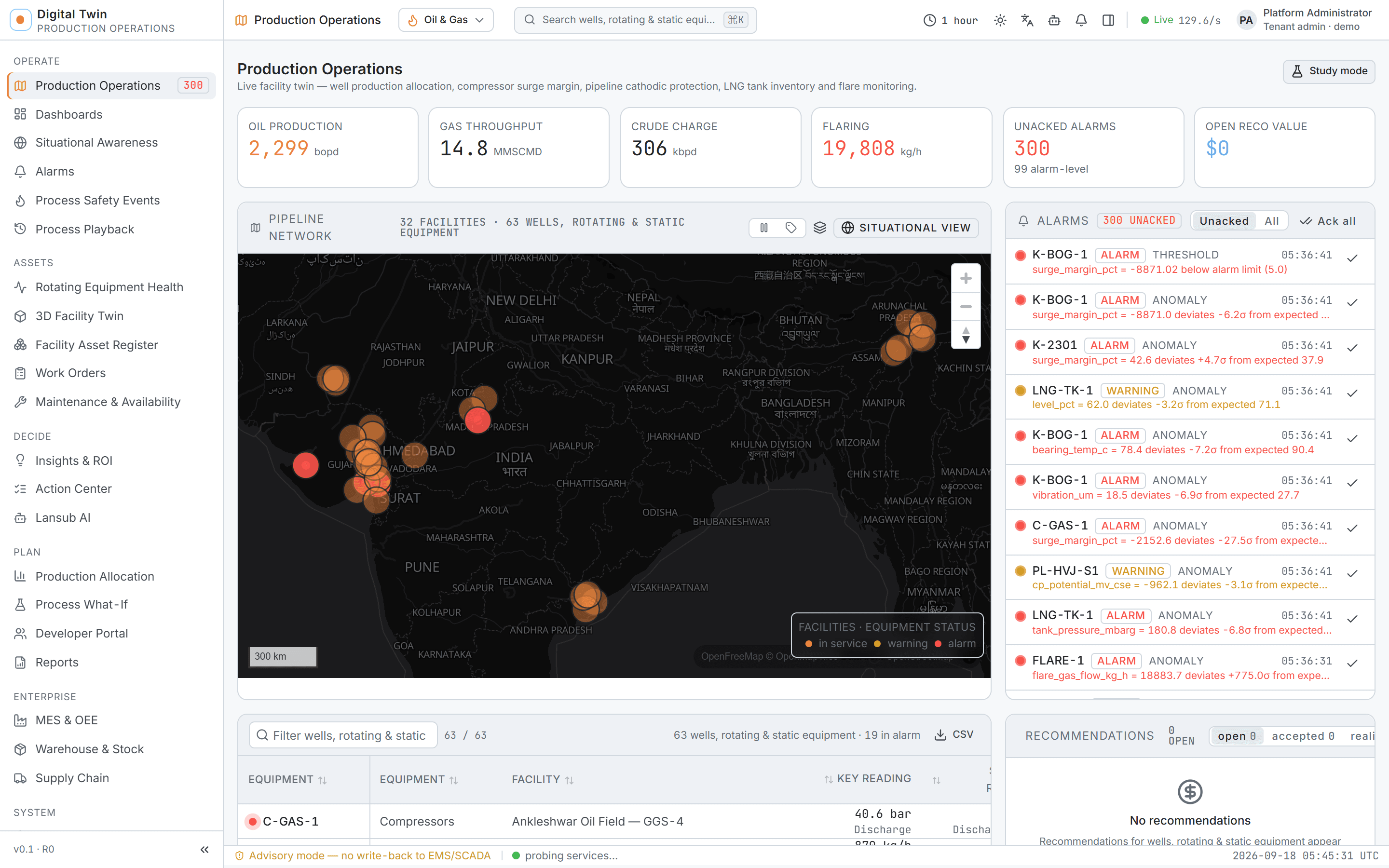
- ESD valves, flare and tank events in the situational picture
- Every intervention carries its expected and realised value
Case study · reference twin
Reference deployment · Vijaipur compressor station surge margin
Two 13 MW gas-turbine-driven compressors move 12 MMscmd through a 36-inch trunk line. Fouling erodes surge margin slowly enough that weekly reviews miss it.
- Surge margin computed live from suction/discharge conditions per machine
- ISO 10816 vibration severity with process context ranks the trains by risk
- Recommendation carries deferred-production cost; wash scheduled at the next window
Runs end-to-end on the HVJ Gas Pipeline — Vijaipur CS reference twin (Madhya Pradesh) — real geography and plant configuration, synthetic telemetry. Reproduce every number in the live demo.
Implementation
Live in 90 days, advisory-first.
Read-only: station DCS/historian, vibration systems, pipeline SCADA. ESD systems are observed, never commanded, in the pilot.
Weeks 1–3 · Connect
Compressor stations, process trains and pipeline segments connected read-only; P&ID-aligned asset model.
Exit · One operating picture across the corridor
Weeks 4–8 · Model & baseline
ISO 10816 severity with process context; surge margins, fouling trends and ESD valve health baselined.
Exit · Machine health ranked by production risk
Weeks 9–12 · Advisory live
Recommendations with deferred-production cost; incident flow for ESD/flare events; dual-control approvals rehearsed.
Exit · Advisory go-live + first avoided-loss review
Value & ROI
Estimate your case — oil, gas & lng numbers only.
Defaults below are the reference figures for this industry; drag the sliders to your fleet. The full calculator with every industry is on the Value & ROI page.
Throughput protected (compression & processing)
Avoided downtime (compressors & pumps)
Illustrative annual value
- Throughput protected
- 9 MW-e avg
- USD 1.80 M / yr
- Outage hours avoided
- 472 h
- USD 11.81 M / yr
- Total
- USD 13.61 M
- per year, before subscription
ESD events, flaring and tank excursions land in the same incident flow — one audit trail from wellhead to terminal. The 90-day pilot replaces every assumption here with measured numbers from your telemetry and recommendations marked realized.
See it running on the reference twins — or on a sanitised slice of your own telemetry. Try the live SCADA & 3D demo
Request a demoSee Digital Twin on your own network data.
A 45-minute working session with our grid engineers on a sanitised slice of your topology and telemetry, followed by a scoped 90-day pilot proposal.