
Lansub · Operational digital twin for energy assets
Run more power through the grid you already own.
Digital Twin reads the SCADA and sensor data you already collect, works out what every line, transformer and machine can safely do right now, and puts the next action in front of your operators with the physics to back it up.
- equipment classes
- 50+
- telemetry cadence
- 1 s
- console screens
- 28
- industries
- 5
Physics grounded in
IEEE 738-2012IEEE C57.91IEC 61400-12IEC 61724ISO 10816-3IEEE 1547CIGRE TB 601
The problem
Grids are being asked to carry 2030 flows with 1990s ratings, calendar maintenance and scattered data.
We built Digital Twin around six constraints that came up in almost every control-room and asset-management review we sat in.
of real line capacity hidden by static seasonal ratings
Static ratings assume worst-case weather all season. On most hours the conductor could carry far more. That margin shows up instead as congestion cost, curtailment and multi-year upgrade projects.
Source · GE Vernova software-only DLR references; research/01
of renewable LCOE is O&M
Turbines, inverters and batteries generate thousands of alarms but little foresight. Failures are found by calendar or by outage rather than by condition.
Source · GE Digital Wind Farm; research/02
lead time for a large power transformer
When replacement takes years, knowing the true ageing rate of the units you own (IEEE C57.91 hot-spot, loss-of-life) is worth more than any spare.
Source · Supply-chain constraint; research/02
grid bottleneck: the interconnection queue
Developers wait years while feeders sit with unknown hosting capacity. Screening is manual, evidence is scattered and every study starts from scratch.
Source · DOE iQMS / LBNL; research/01
annual grid investment needed by 2030 (vs. USD 400 B/yr today)
You cannot build your way out on that timeline. Operators need to extract more from existing assets, safely and with evidence regulators accept.
Source · IEA via IBM; research/01
is the most-cited blocker to digital twins in energy
SCADA, historians, EAM, GIS and weather live in separate systems with separate identities. Without a shared model there is no twin, only dashboards.
Source · POWER Magazine, Cyient, IBM; research/01
How it works
Connect. Model. Act. Live on your telemetry inside 90 days.
No rip-and-replace. Digital Twin reads from the systems you already run, models what the data means physically, and hands your team decisions they can defend.
Connect
01Read-only connectors for SCADA, historians, MQTT / Sparkplug B, OPC UA, Modbus, LoRaWAN (ChirpStack / TTN) and plain webhooks. Telemetry is validated once and fans out to every engine. Nothing writes back until you certify it.
Model
02A CIM/CGMES-aligned twin graph joins your assets to live data. Physics engines score every line, transformer, turbine and feeder each second: ratings, health, remaining life and per-tag data quality, each traceable to its standard.
Act
03Recommendations arrive with expected MW, expected USD and confidence. Dual-control approvals, work orders and a hash-chained ledger track every decision through to the value it produced.
How value is created
A conductor's real limit changes every minute. Digital Twin computes it, forecasts it and shows exactly how much is dispatchable.
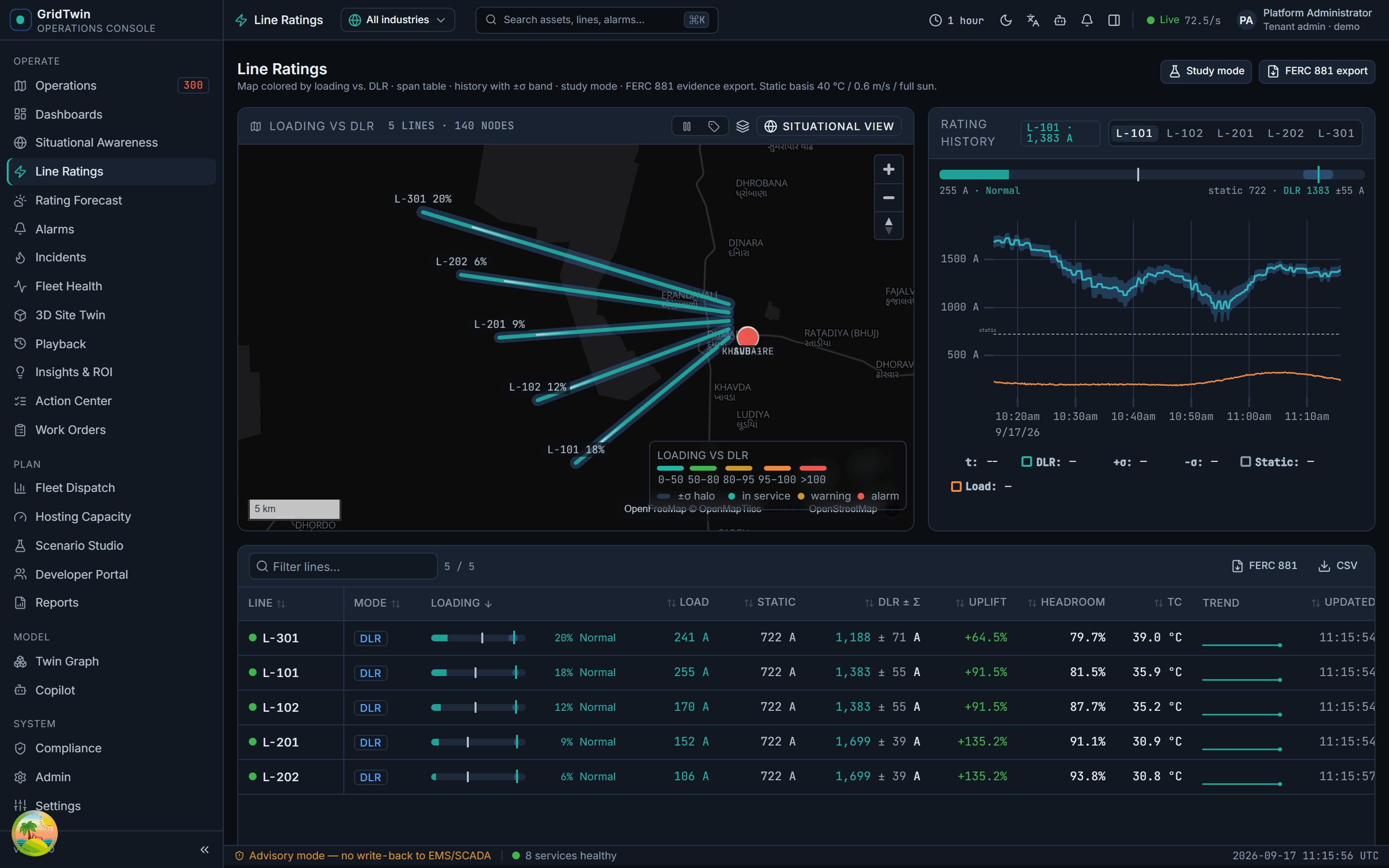
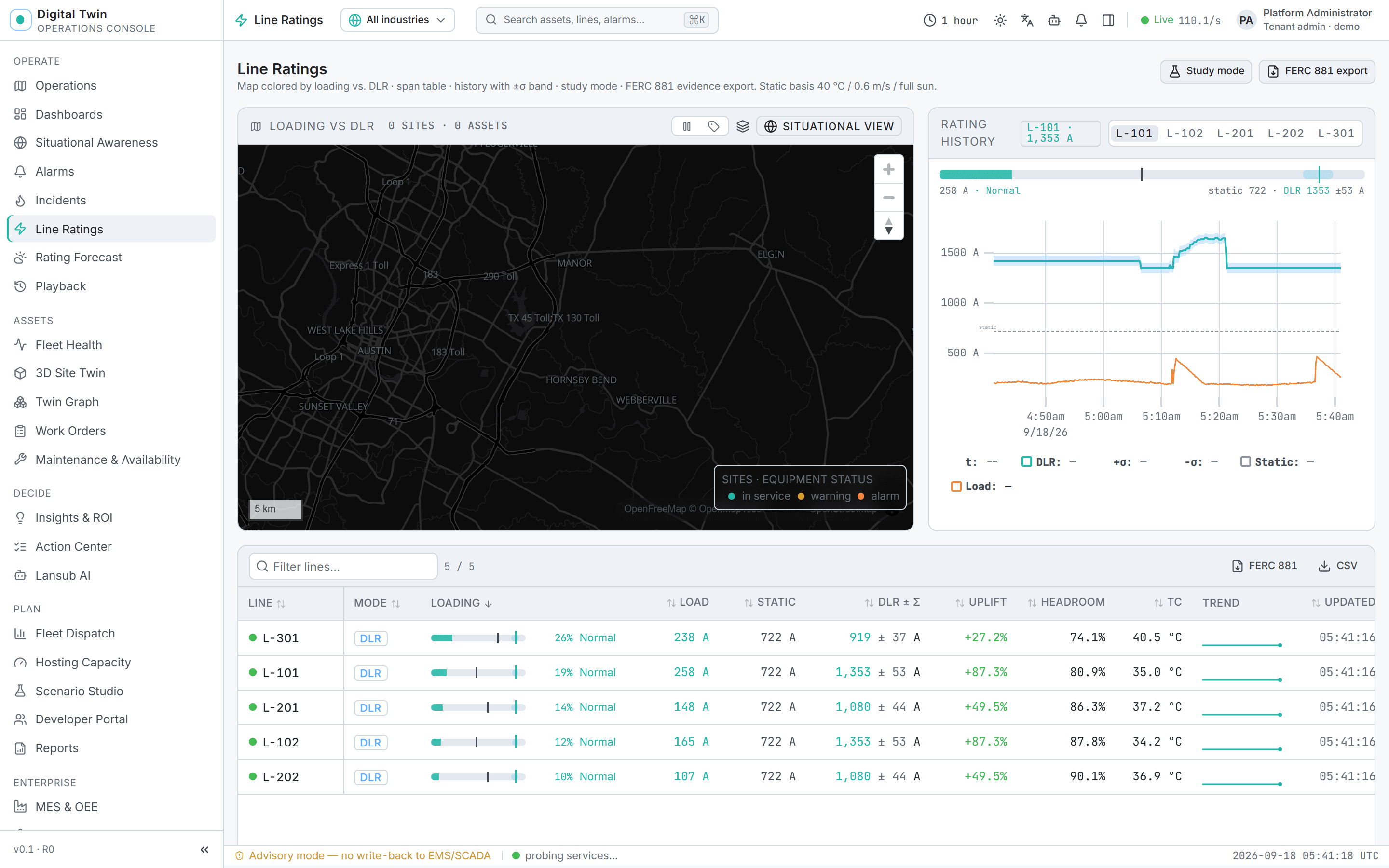
We solve the IEEE 738-2012 heat balance per line span against live weather cells and measured load: Joule heating in, convective and radiative cooling out, solar gain on top. The shaded area is capacity a static rating leaves unused.
- Inputs
- ambient, wind speed & angle, solar, measured load
- Model
- IEEE 738-2012 steady-state heat balance, per span
- Output
- amps the conductor can carry now, with ±1σ uncertainty
more line capacity from software-only dynamic ratings
GE Vernova reference
renewable curtailment reduction in a UK DLR demonstrator
IJEPES citation
less downtime and up to 5-year life extension with fleet PdM
GE Digital Wind Farm reference
pilot time-to-value on your own telemetry
Digital Twin pilot design
The product
One console. Every module runs on the same twin, the same events and the same ledger.
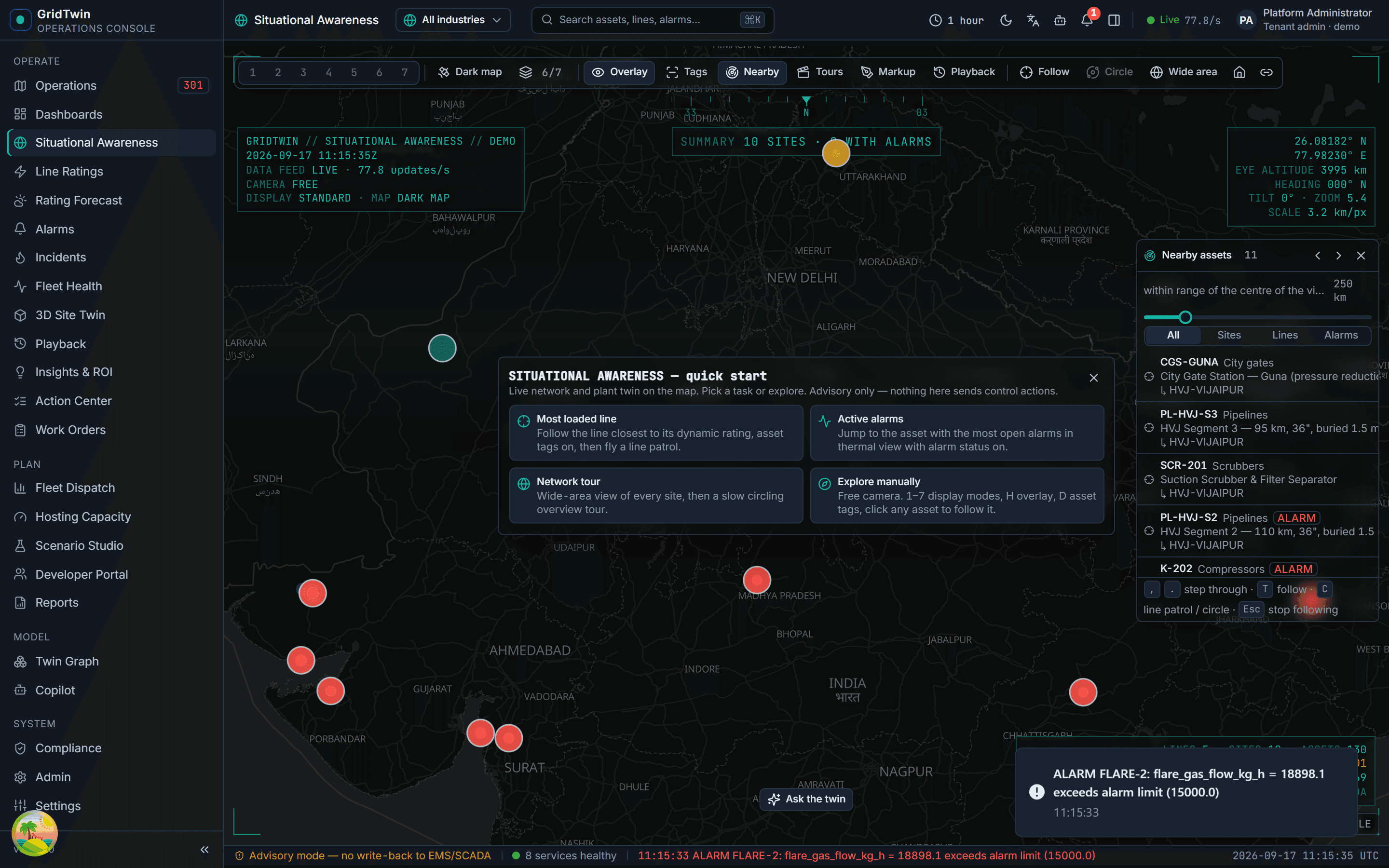
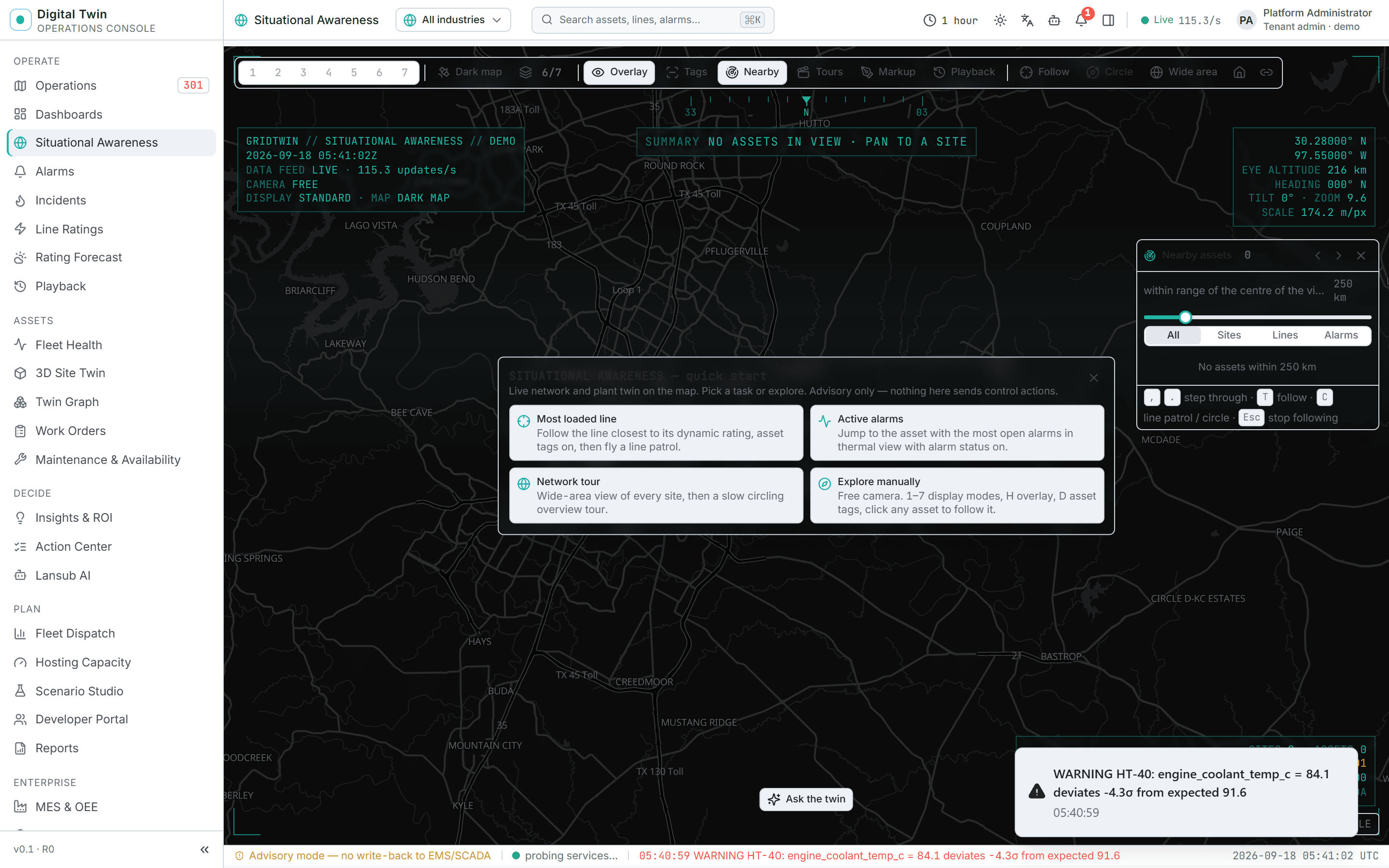
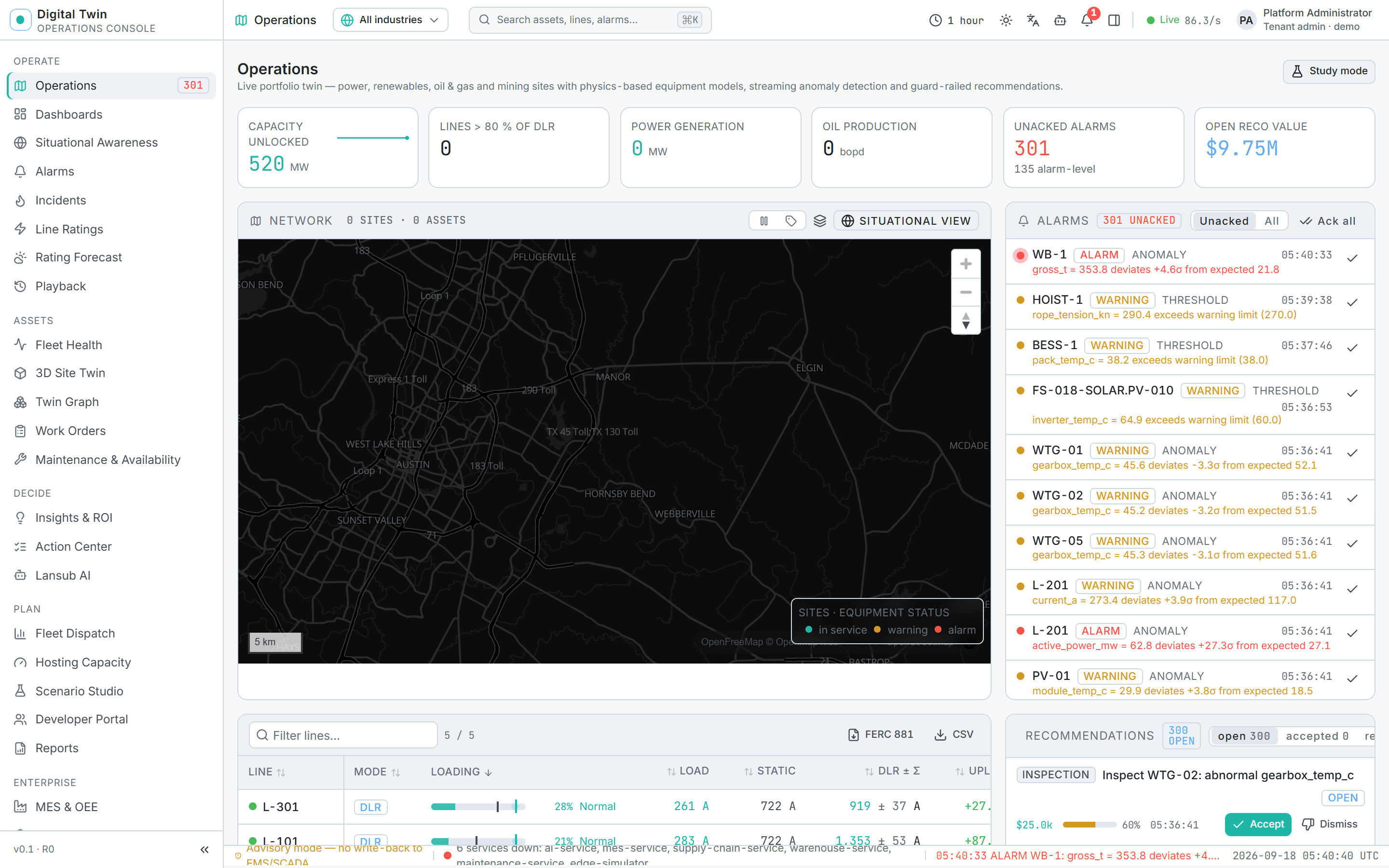
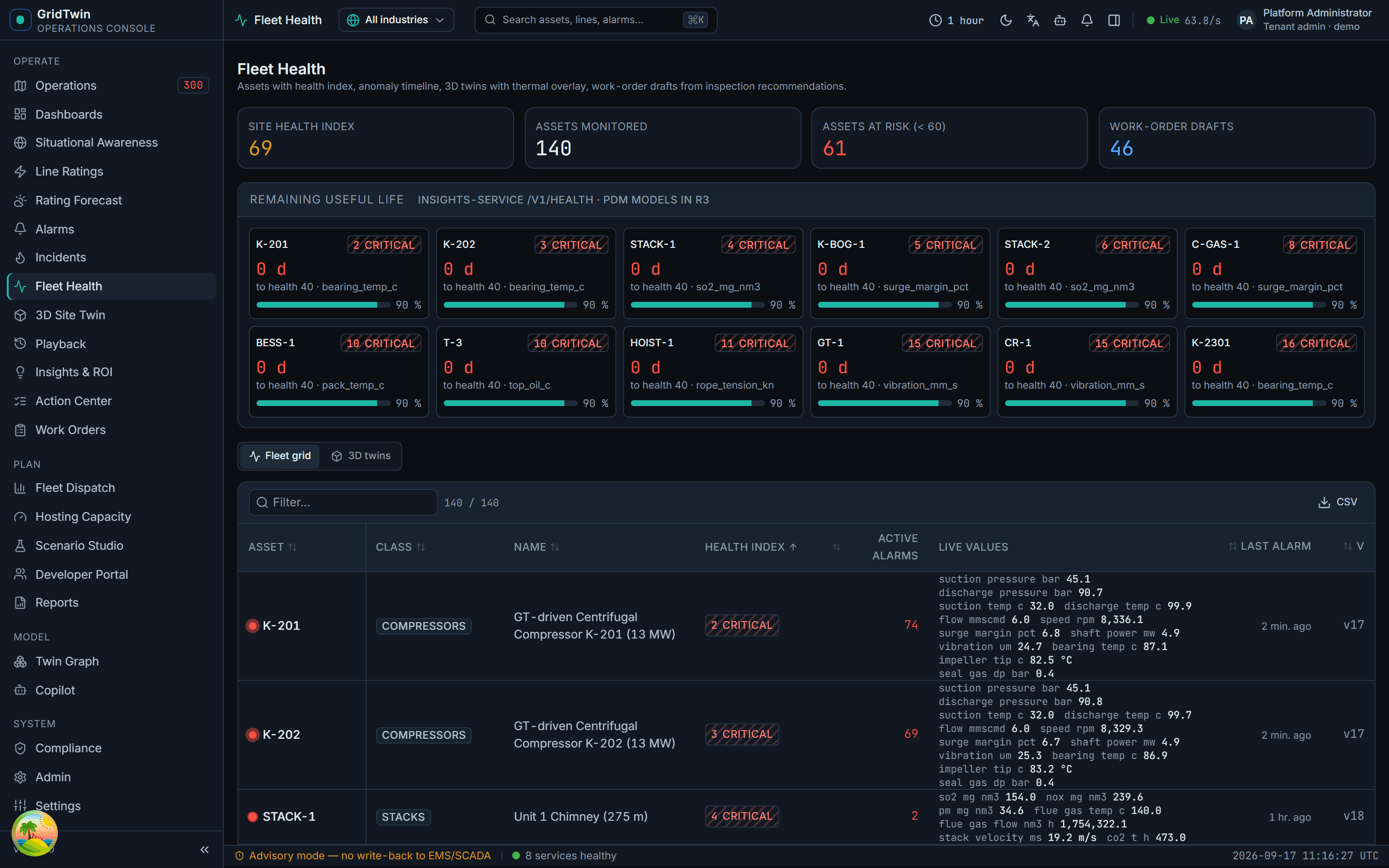
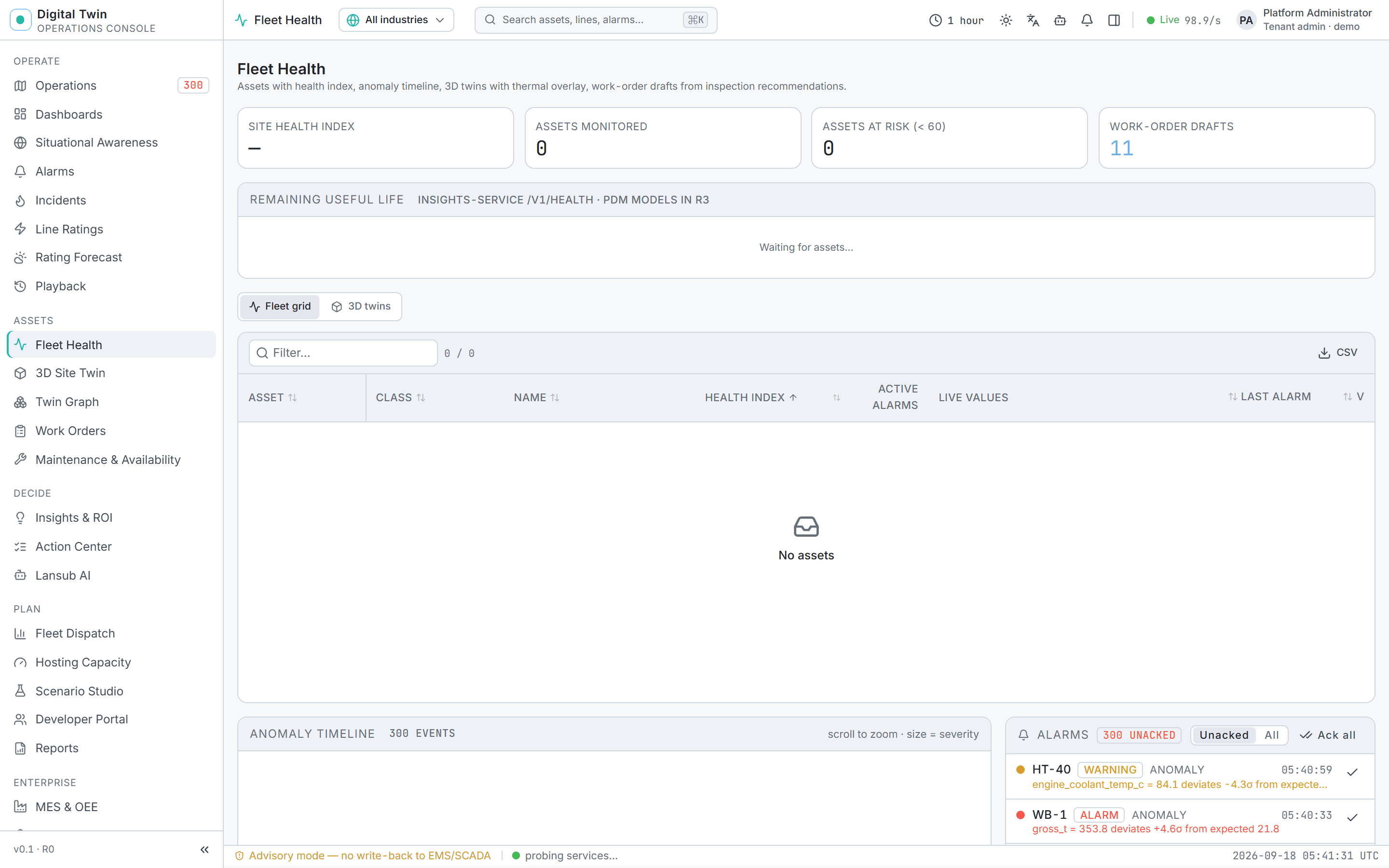
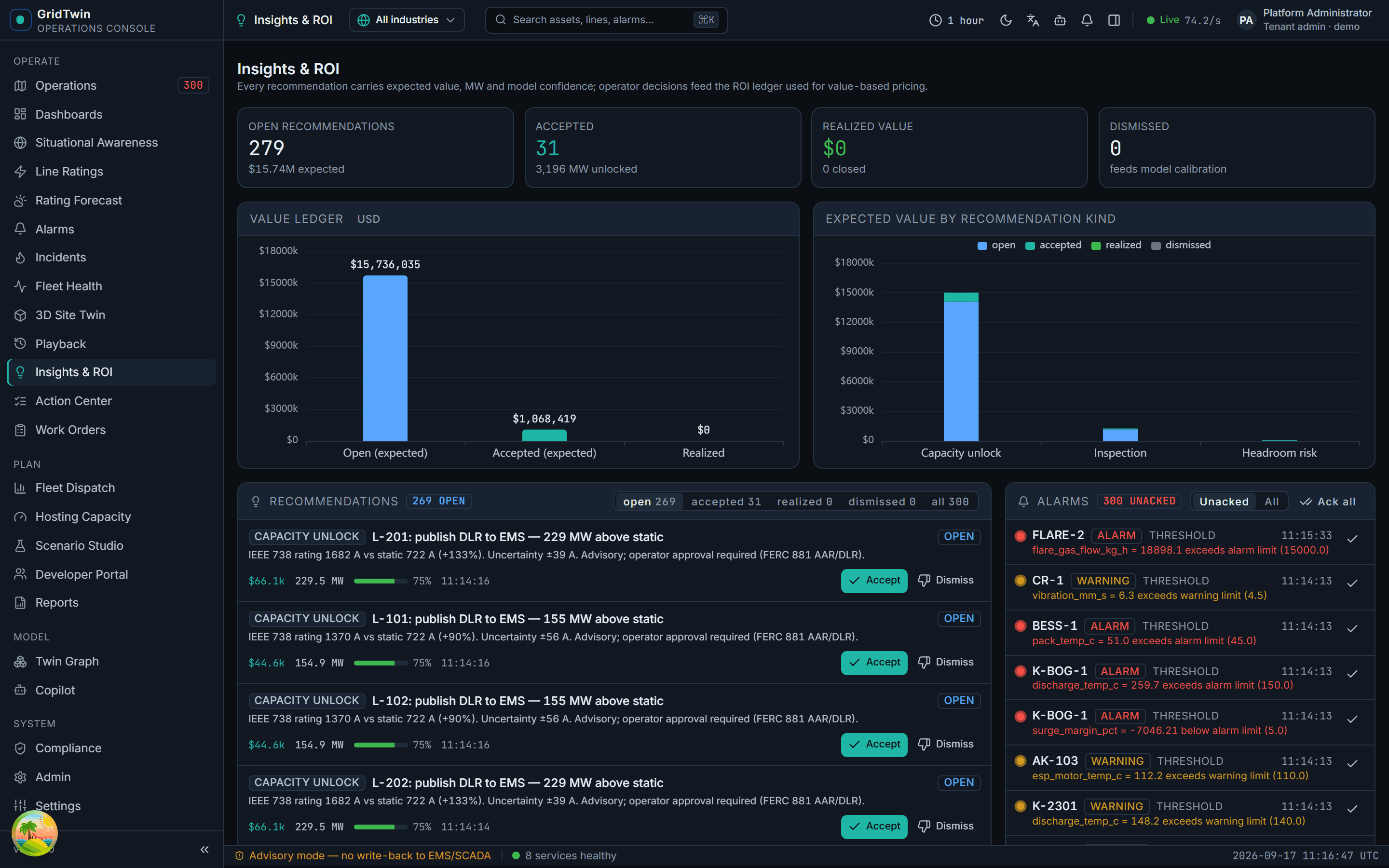
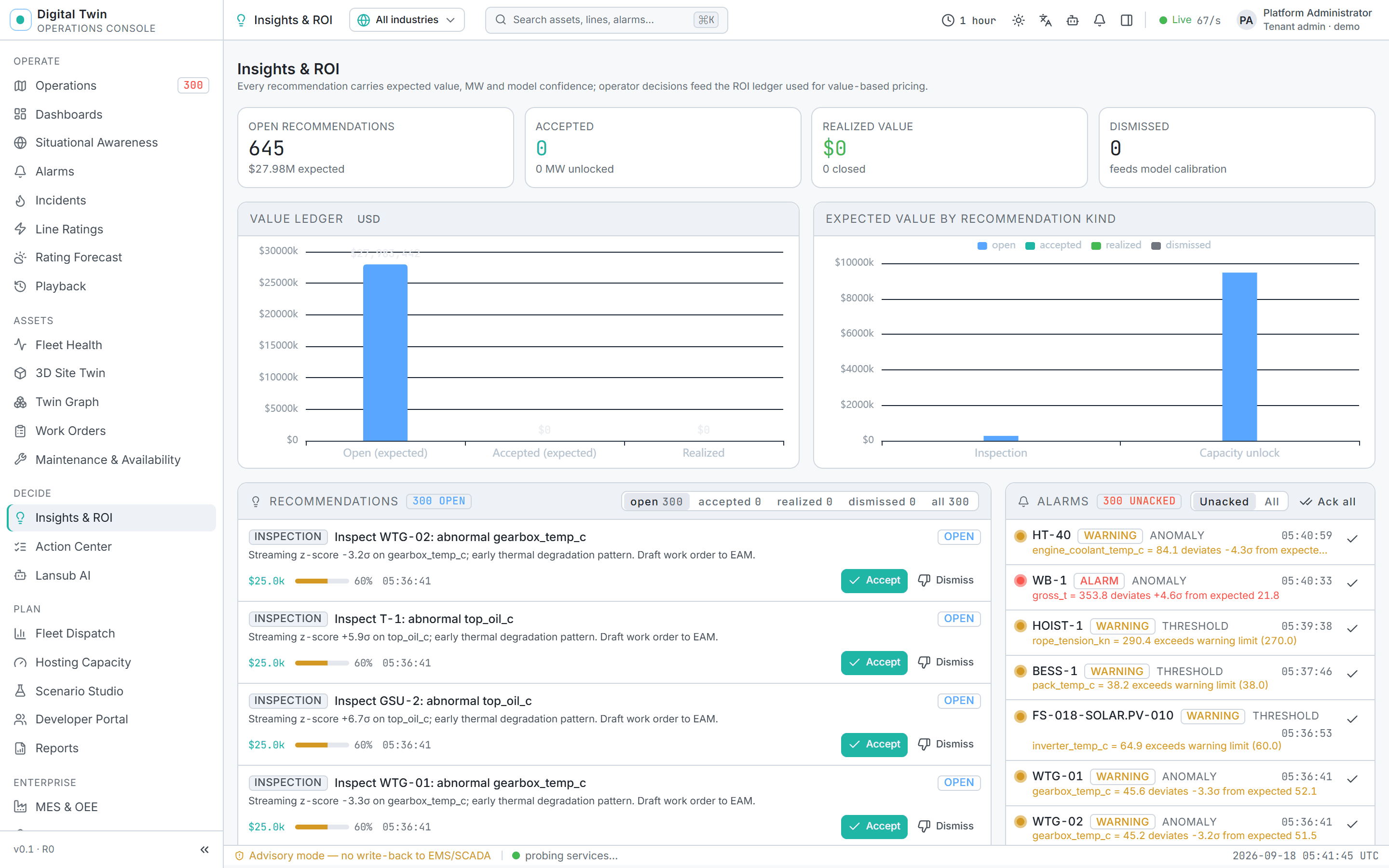
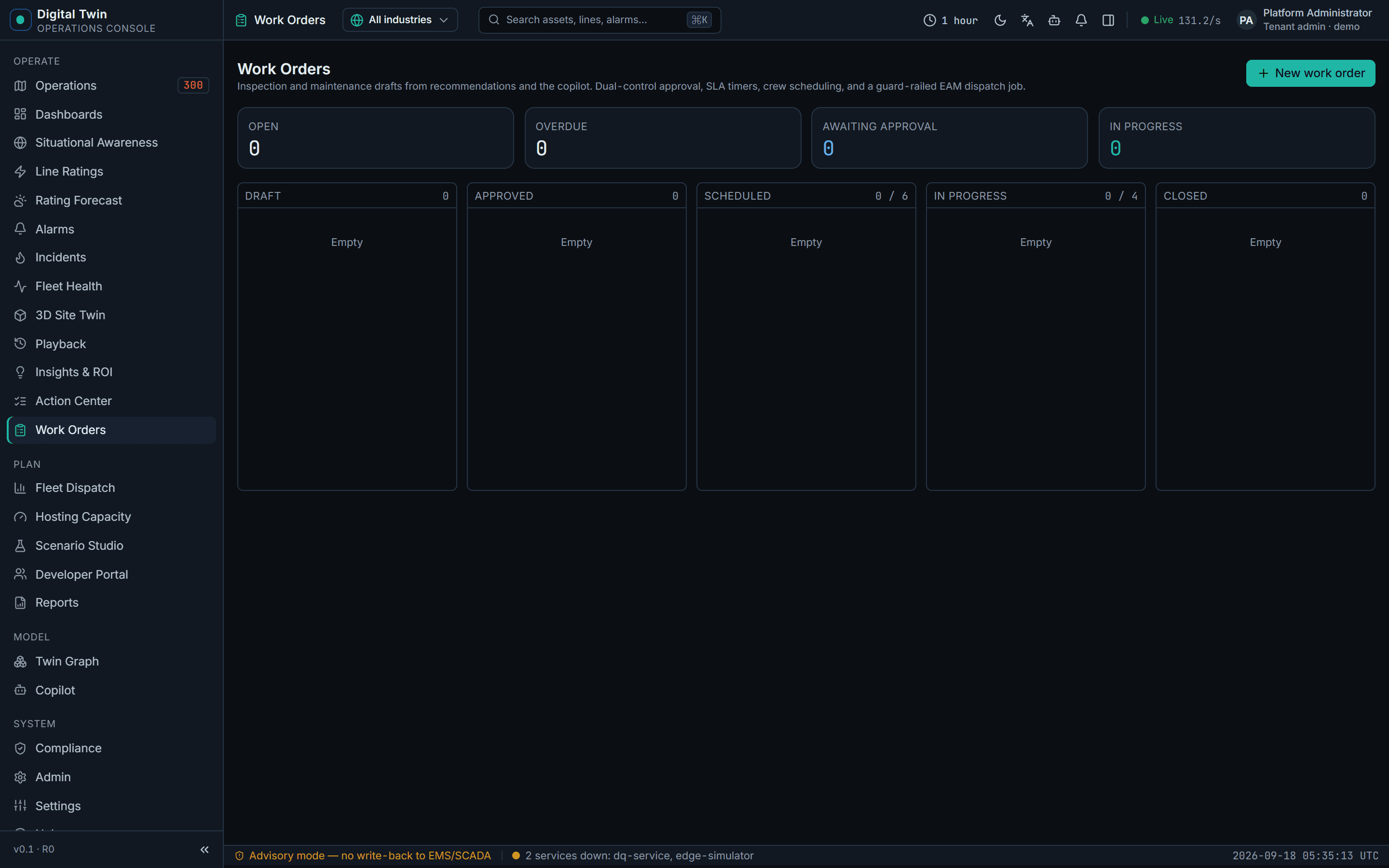
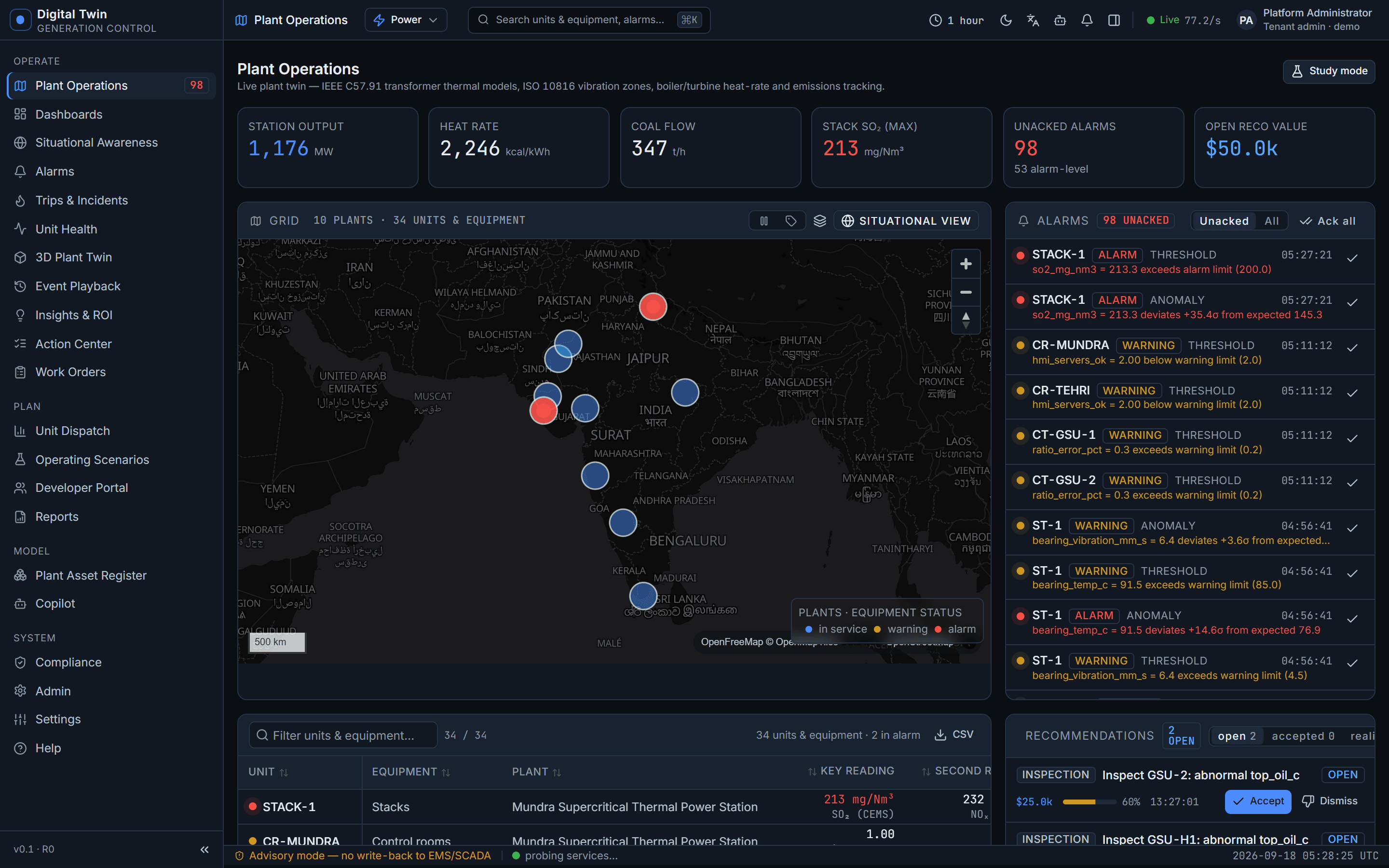
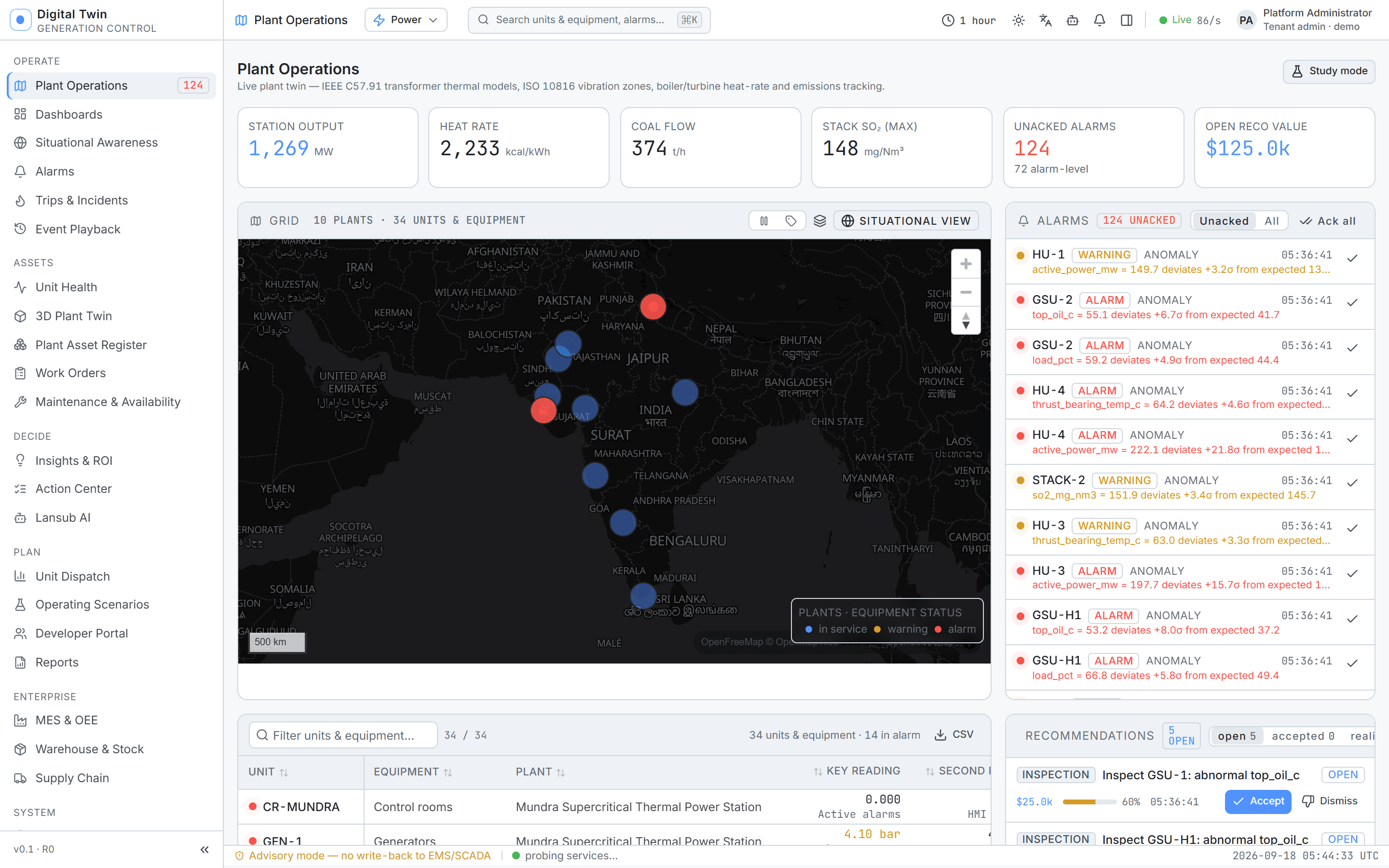
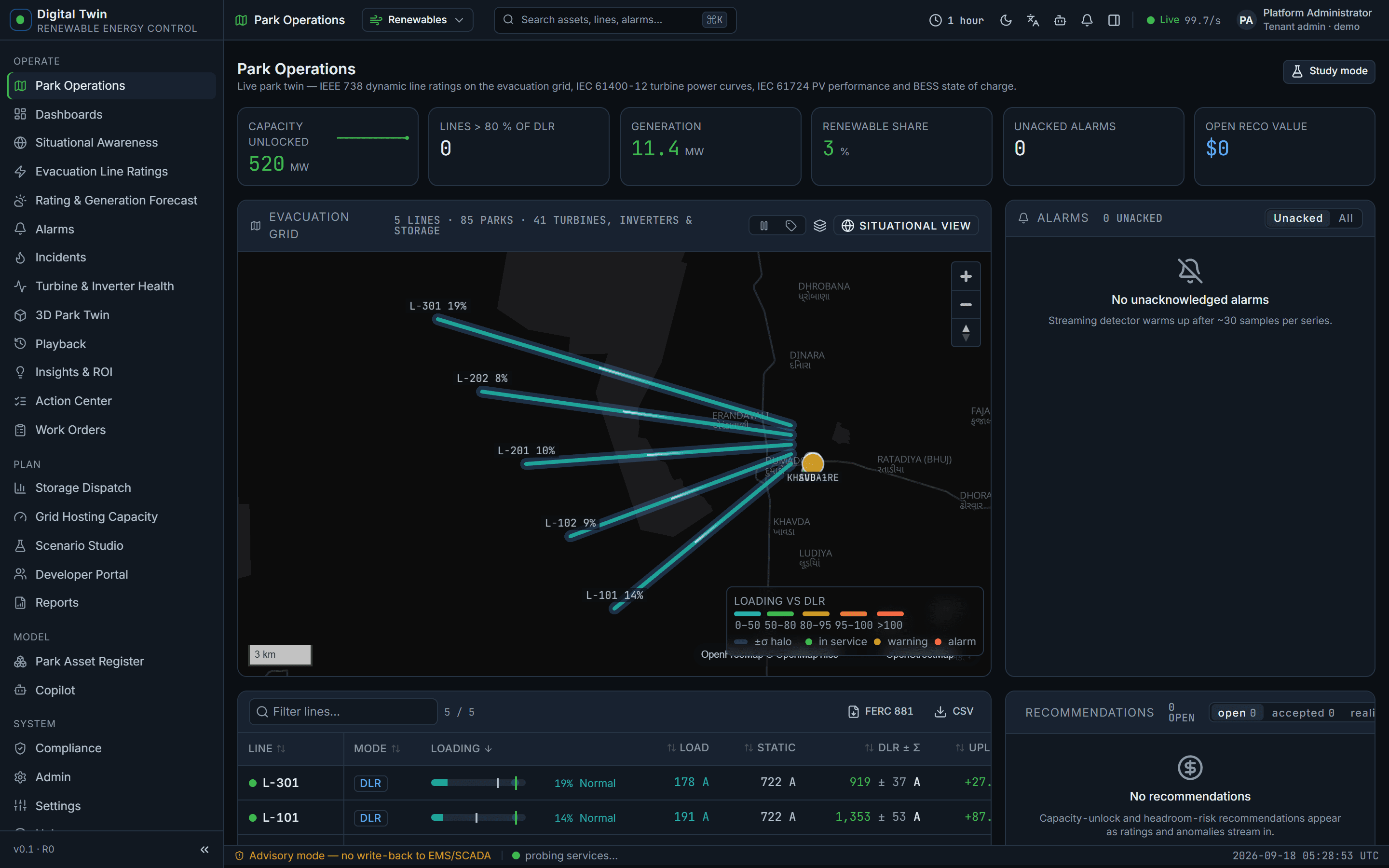
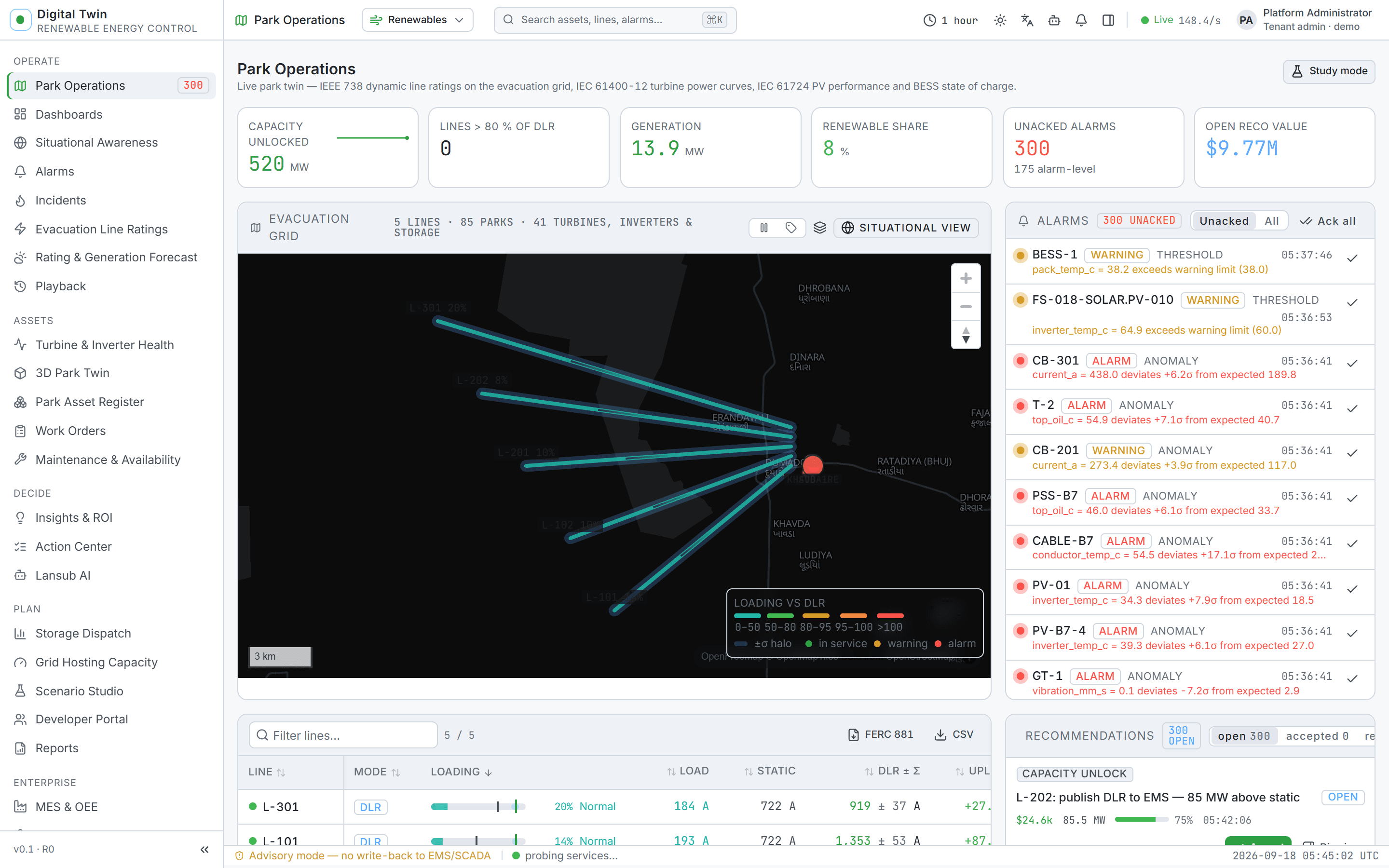
Every screen below is captured from the running platform. Each KPI, alarm and rating on it was computed by a service you can inspect.
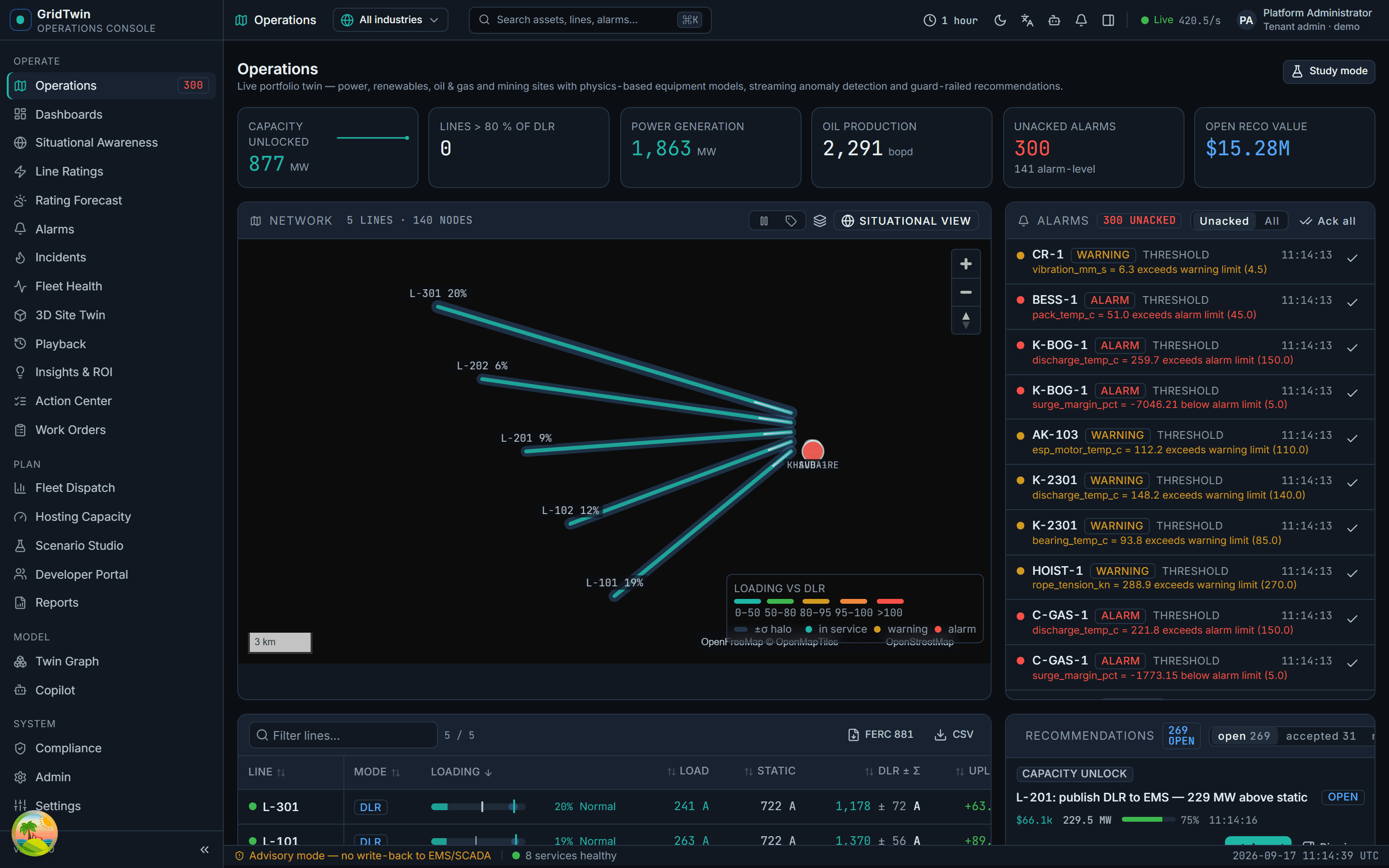
Dynamic line ratings & forecast
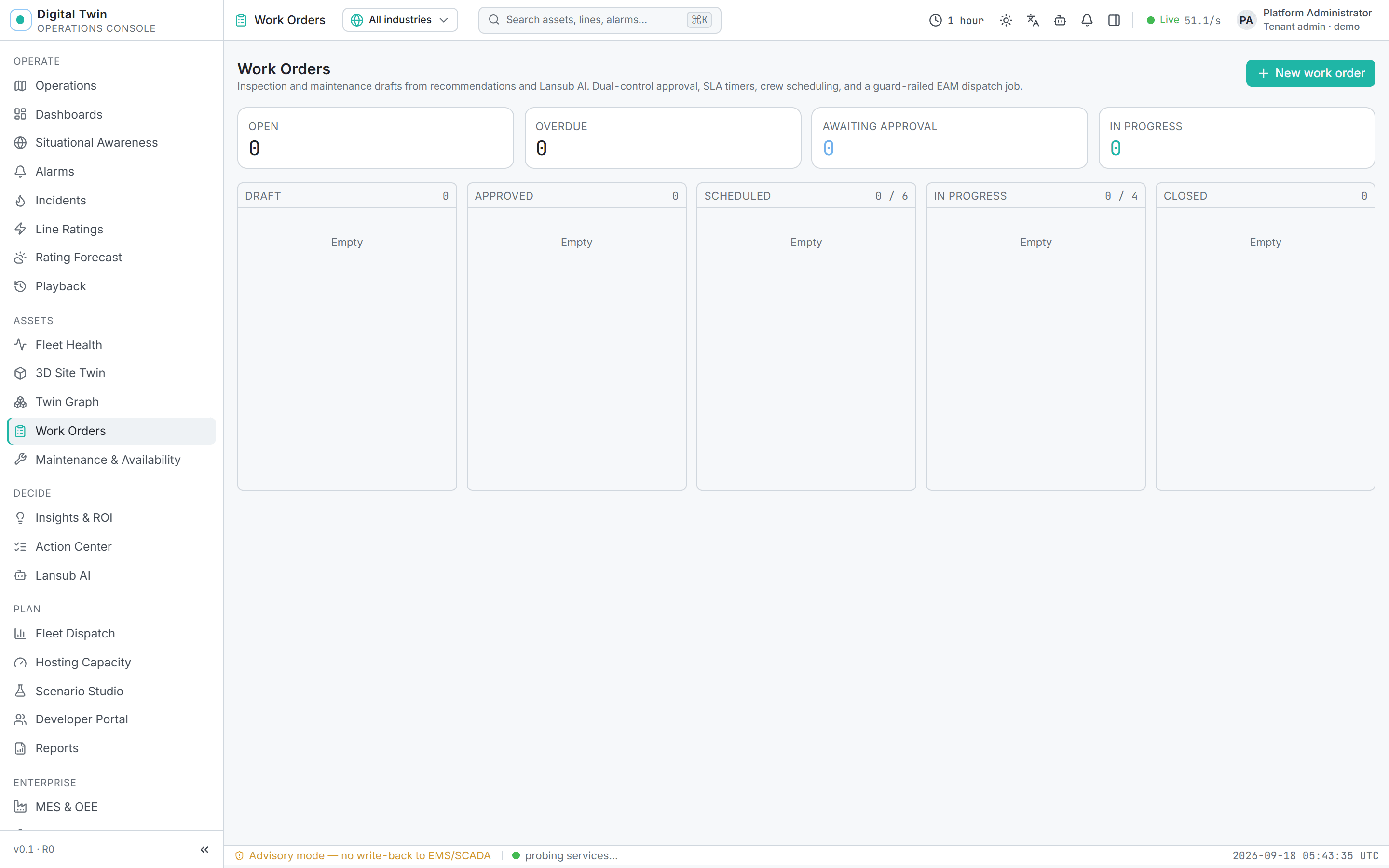
01IEEE 738-2012 steady-state heat balance on live weather cells and measured load. Real-time DLR, 0–240 h forecast with 1-σ uncertainty bands, study mode and FERC 881-style evidence export.
IEEE 738-2012CIGRE TB 601 (R2)
Situational awareness (God's Eye)
02One geospatial operating picture across every site: flows, ratings, alarms, health. Seven display modes, tours, follow-mode, whiteboard markup, time travel and natural-language commands.
7 display modesguided tours
Fleet & asset health
03Health index and remaining useful life per asset from physics-informed models: transformer hot-spot ageing, wind power-curve deviation, PV performance ratio, ISO 10816 vibration zones, breaker contact wear.
IEEE C57.91IEC 61400-12IEC 61724ISO 10816-3IEC 62271
3D site twin
04Substations, plants, wind and solar parks, refineries and mines in 3D with live sensor overlays, thermal views, inspection mode and what-if physics per equipment.
live sensor overlayswhat-if physics
Insights, recommendations & ROI ledger
05Streaming anomaly detection plus threshold alarms with hysteresis on 60+ tags. Every recommendation carries expected MW, expected USD and confidence; status tracks open → accepted → realised.
expected vs realisedconfidence-scored
Incidents, work orders & dispatch
06Alarm-to-crew workflow with SLA timers, dual-control approvals (second approver enforced server-side), fleet dispatch and a SHA-256 hash-chained audit ledger.
dual controlSLA timers
Enterprise operations: MES, stock & supply chain
07Production orders and OEE per work center, spare-parts stock with reorder points, purchase orders with supplier OTIF and shipment risk, and maintenance plans tied to asset health — all on the same twin and event backbone.
OEEOTIFMTBF / MTTR
Hosting capacity & developer portal
08Feeder-level hosting capacity with smart-inverter and flexible-interconnect options, IEEE 1547 screening, 8760-hour profiles and a persisted interconnection queue with stage SLAs.
IEEE 1547DC power flow
Scenario studio & playback
09DC power-flow engine with island detection for outage, weather and load scenarios; full historical playback of the twin state.
DC power flowisland detection
Data quality scoring
10Per-tag 0–100 quality score from gap, flatline, spike and drift detectors, so operators know when a number cannot be trusted before they act on it.
gap · flatline · spike · drift
Lansub AI — self-hosted operations agent
11A small language model that runs entirely inside your perimeter — no telemetry leaves the site. It reads every module (twin, alarms, health, MES, stock, supply chain, maintenance), answers with citations, drafts governed actions and learns from outcomes and operator feedback.
62 toolsself-hosted SLMepisodic memory
Compliance & administration
12Tenants, users and roles, API keys, integrations, retention tiers, ontology versions, feature flags and the audit ledger, with identity provided by the built-in identity service.
RBAC · 6 roleshash-chained audit
End to end
From a sensor reading to a signed-off, valued action in one auditable loop.
This is the actual path an event takes through the services. Hover a step to read what happens there.
- 1
Ingest
Edge collectors post telemetry batches; every batch is validated against a versioned contract before it enters the twin.
1 s cadence · quality codes
- 2
Model
Rating, health and quality engines score every line, machine and tag against its governing standard, every second.
IEEE 738 · C57.91 · ISO 10816
- 3
Detect
Threshold alarms with hysteresis and streaming anomalies; a CAPACITY_UNLOCK or INSPECTION recommendation is created with expected MW / USD / confidence.
alarms · recommendations
- 4
Decide
An operator accepts in Action Center. High-impact kinds require a second approver — self-approval is rejected server-side.
approvals · dual control
- 5
Act
A work order or dispatch is created and tracked to closure; write-back to EMS/EAM stays behind a feature flag until the connector is certified.
work orders · dispatch
- 6
Prove
The recommendation is marked realised with the value actually delivered; every step is a SHA-256 chained entry in the audit ledger.
audit ledger · ROI
Physics, not heuristics
Health index derives from the standard's ageing acceleration factor, oil and winding temperatures and load history — so an engineer can trace every point of the score.
Guard-railed actions
- reco.accepted by operator@…L-201 CAPACITY_UNLOCK +38 MW45384540f…
Dual-control approvals reject self-approval server-side. Every entry hashes the previous one, so the ledger cannot be edited without detection.
Advisory first
Digital Twin ships in advisory mode. Write-back to EMS and EAM systems is behind a tenant feature flag and only enabled after the connector is certified with your operations team — the status bar says so on every screen.
Lansub AI
An operations agent that lives inside your perimeter and learns your plant.
Lansub AI is a small language model that runs entirely on your own hardware. It answers from the twin with citations, drafts governed actions, and runs an autopilot for the routine so your team handles the exceptions. No prompts, tags or telemetry ever leave the site.
Self-hosted, air-gap friendly
Runs inside your network. A compact base model plus a plant-tuned model rebuilt from your own best episodes. Ships in the same installers as the rest of the platform — cloud, on-premises or air-gapped.
Reads and acts across every module
62 tools spanning twin, ratings, alarms, health, data quality, MES, warehouse, supply chain, maintenance, SCADA and governance. Write actions are separately flagged, identity-stamped and recorded in the audit ledger.
Autopilot with guardrails
Four modes: off, observe, suggest, act. Dollar limits on auto-approvals, parts-readiness checks, dual-control escalation for high-value actions, a hard cap of 8 actions per cycle, and automatic veto of any skill whose measured outcomes go negative.
Learns from outcomes, not just clicks
Every action is scored later: did the work order progress, did the shipment arrive, did the stockout clear. Episodic memory grounds each answer in what worked before; thumbs-up / thumbs-down tunes tool choice per intent.
Architecture
Event-driven, standards-based, deployable anywhere.
Every reading is validated once and delivered to every engine. Each engine scales independently and can be evolved without touching the console.
Industries & equipment
Physics models for the asset classes that fail expensively.
The platform ships with 50+ CIM-aligned equipment classes, each carrying the standard that governs its limits. Ten reference twins with real geography and plant configuration (synthetic telemetry) let you explore every industry before connecting a single tag.
Grid & transmission
IEEE 738 · IEEE C57.91 · IEC 62271 · IEC 61287
ACLineSegmentPowerTransformerBreakerUndergroundCableWeatherStation
Renewables & storage
IEC 61400-12 · IEC 61724 · electrochemical SoC/SoH
WindTurbinePhotovoltaicUnitBatteryUnit
Thermal & hydro
heat-rate / creep · hydraulic · structural
BoilerSteamTurbineGeneratorThermalGeneratingUnitHydroUnitPenstockReservoirDam
Oil & gas
ISO 10816-3 vibration · integrity
WellPumpCompressorSeparatorStorageTankPipelineSegmentFlowlineCPRectifierValveManifoldScrubberAirCooler
Refining & LNG
process limits · thermal
DistillationColumnReactorFurnaceHeatExchangerFCCUnitHydrocrackerLNGTankVaporizerCityGateFlareJettyMeteringStation
Mining
ISO 10816 · safety telemetry
HaulTruckExcavatorCrusherConveyorDewateringPumpContinuousMinerHoistMineShaftStrataMonitorMethaneSensorDustMonitorSlopeMonitor
Reference twins shipped with the platform
- KHAVDA-REHybrid renewable park
- MUNDRA-TPPThermal (coal)
- TEHRI-HEPHydro + pumped storage
- BHADLA-SOLARSolar park
- ANKLESHWAR-OILUpstream onshore
- HVJ-VIJAIPURMidstream gas
- JAMNAGAR-REFDownstream refinery
- DAHEJ-LNGLNG regasification
- GEVRA-OCOpen-cast coal
- JHARIA-UGUnderground coal
 Transmission & renewables integrationTSOs, ISOs, G&T cooperatives, transmission asset owners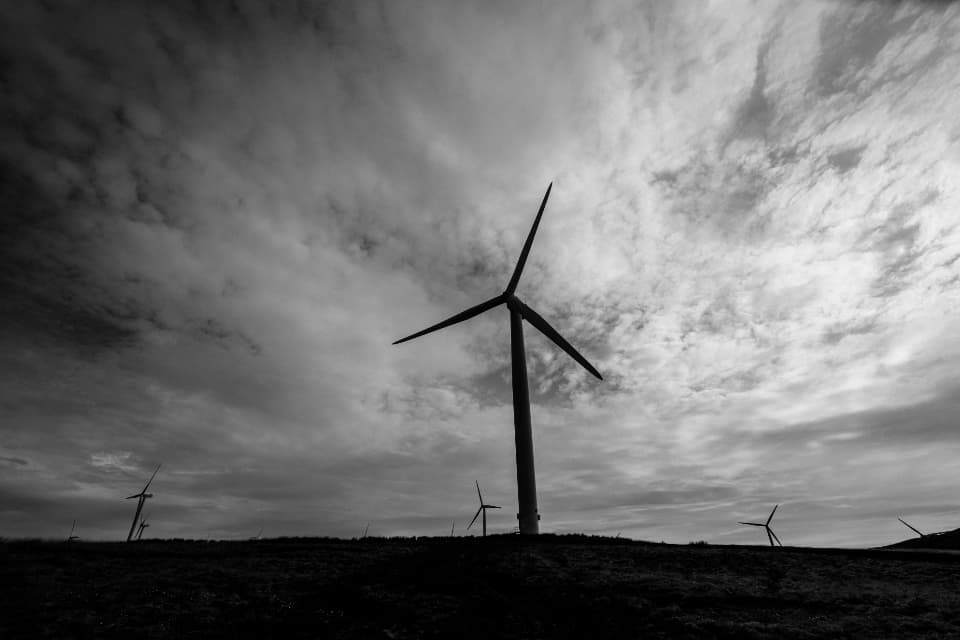
 Wind, solar & storageIPPs, hybrid park operators, O&M providers
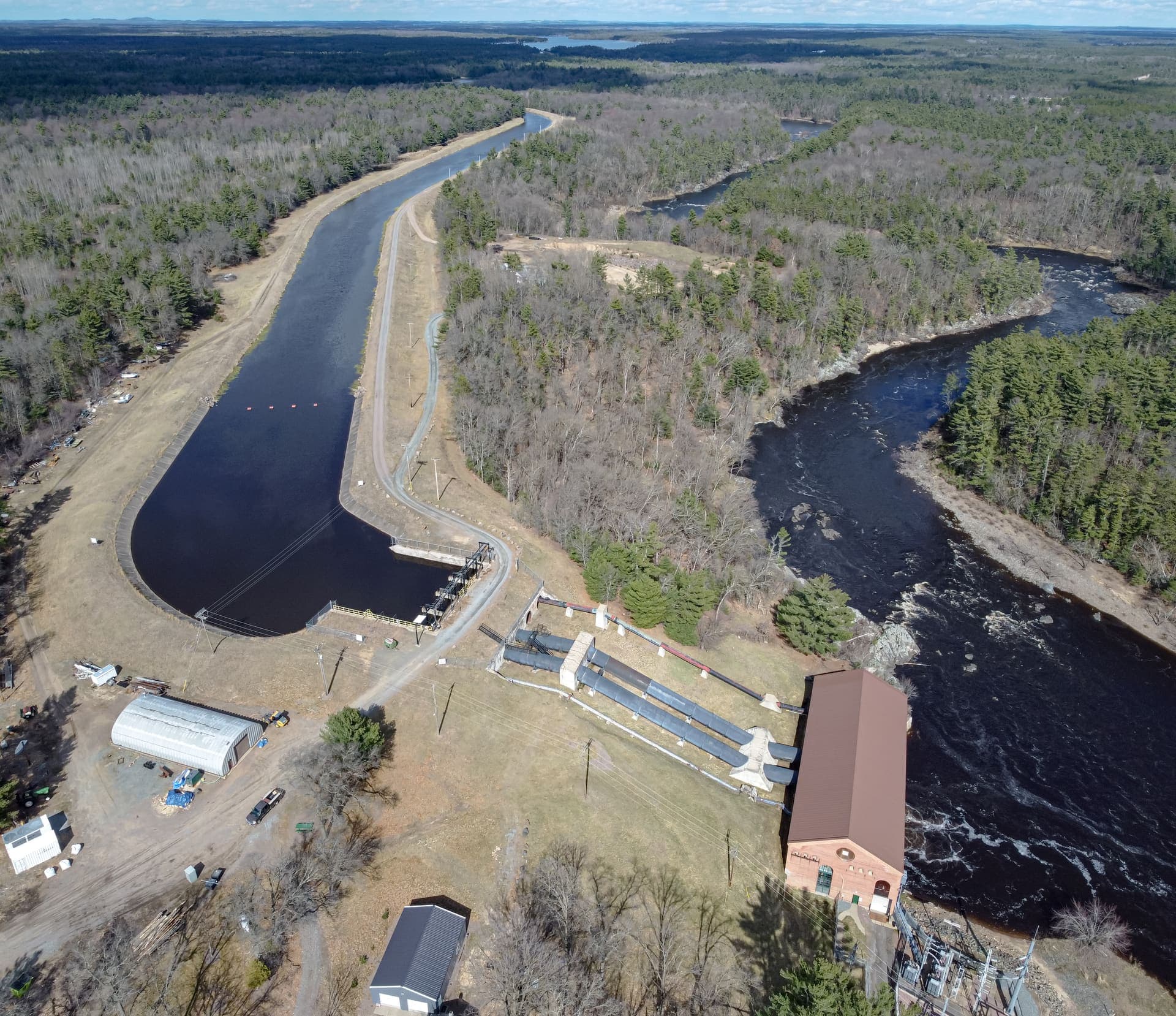 Thermal & hydro generationUtilities and generating companies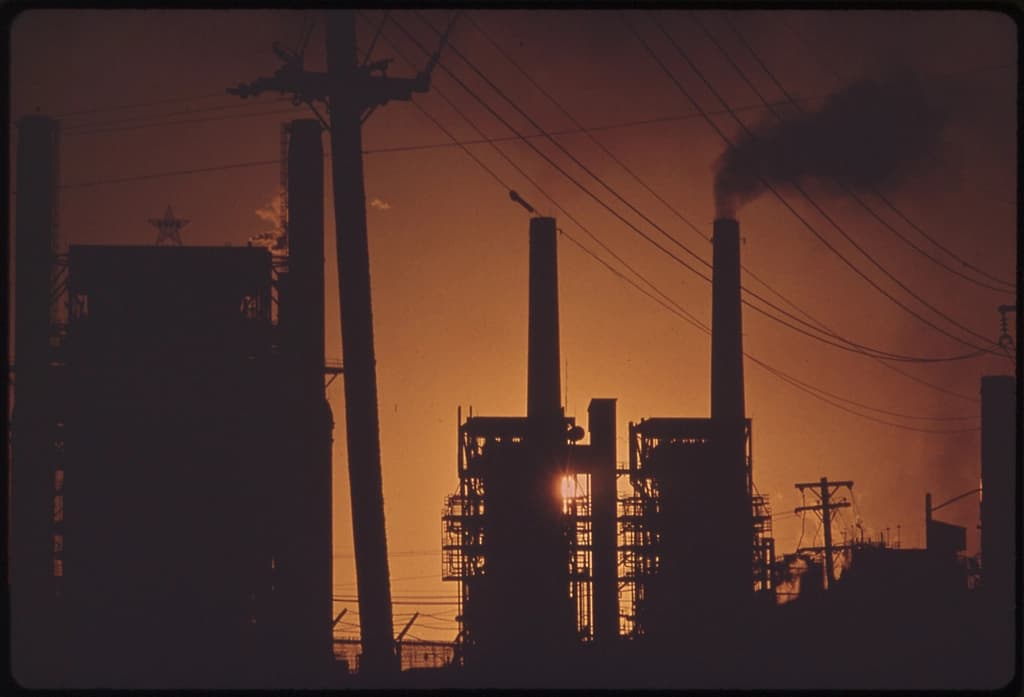
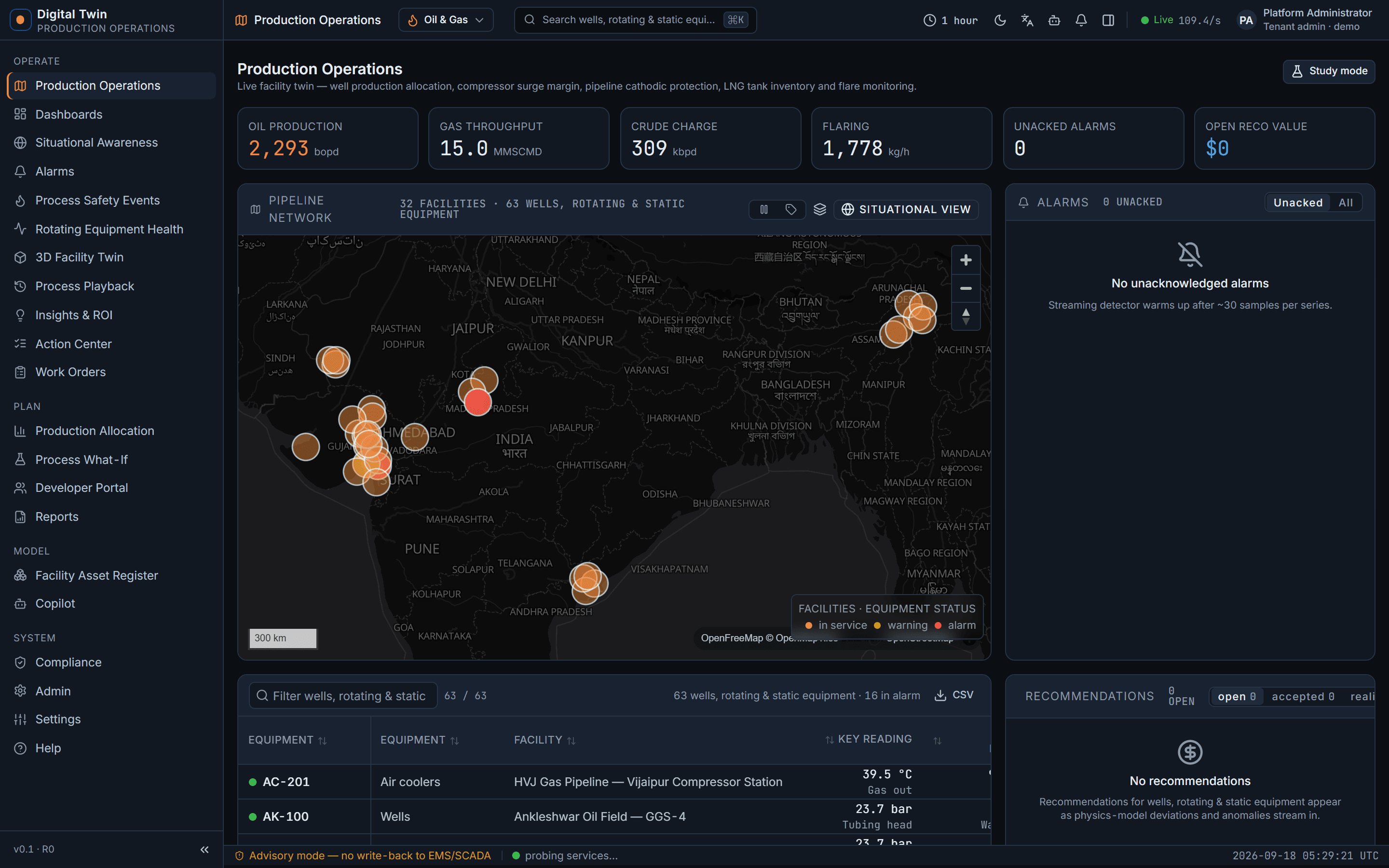
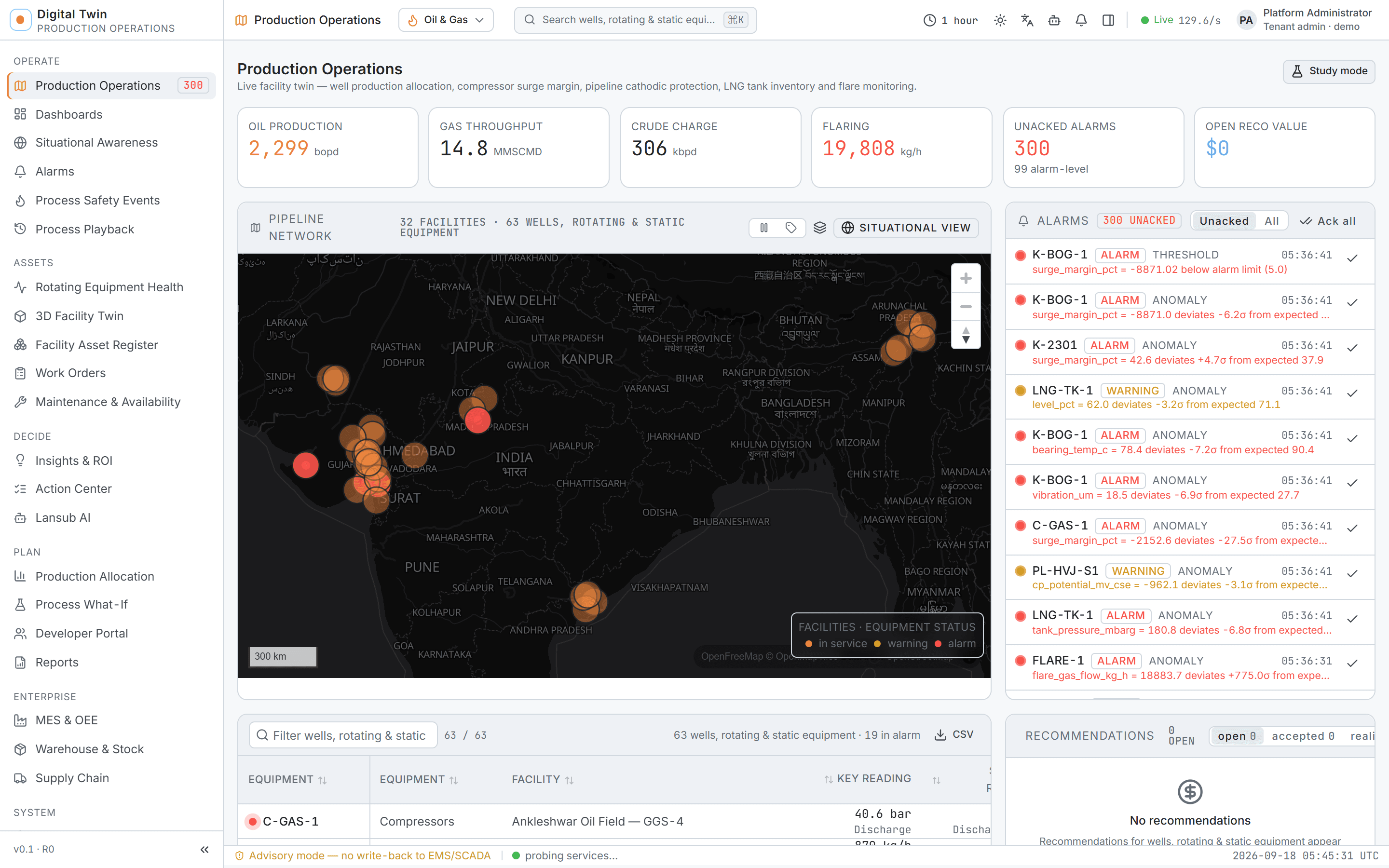 Oil, gas & LNGUpstream, midstream and downstream operators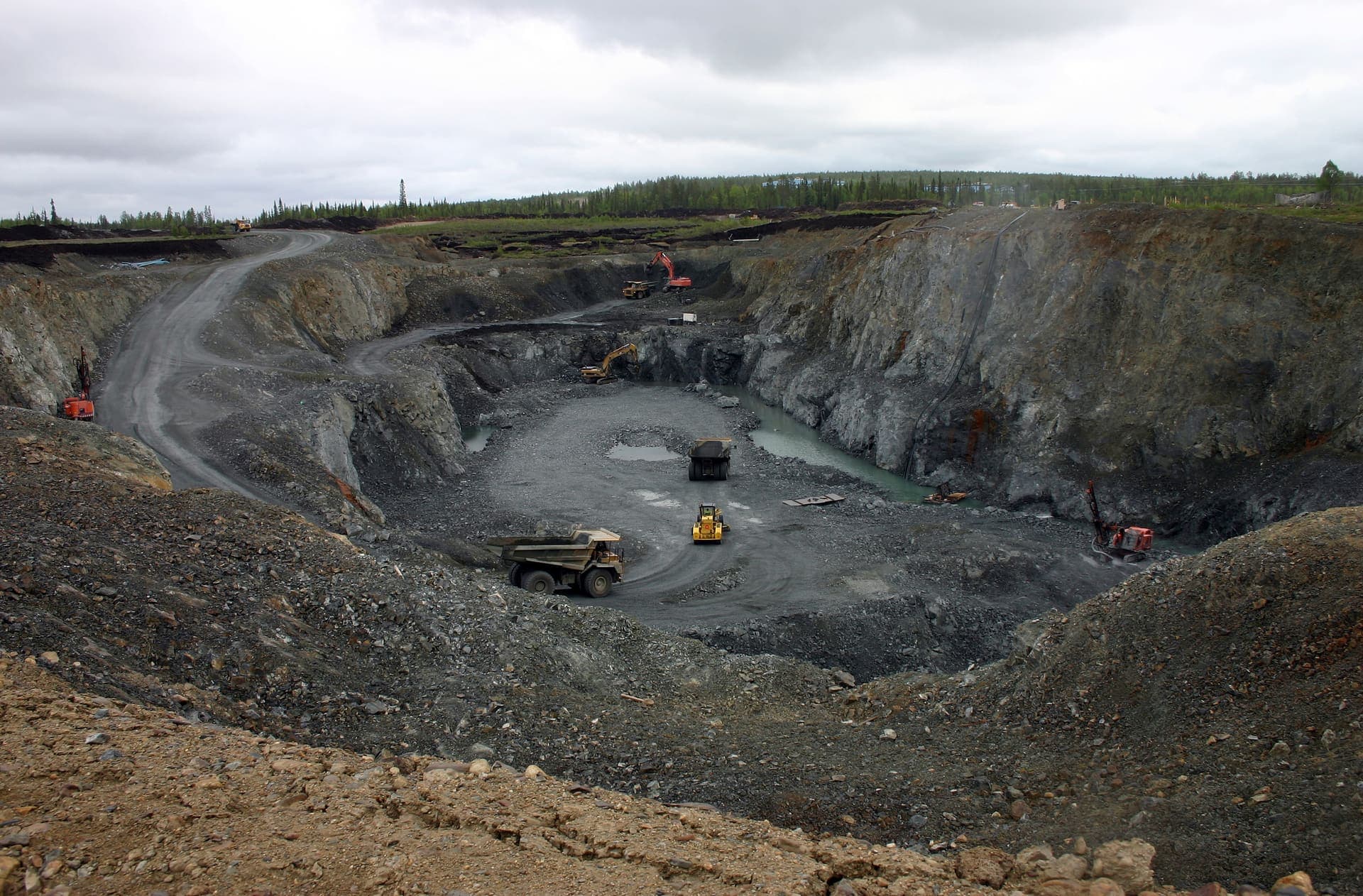
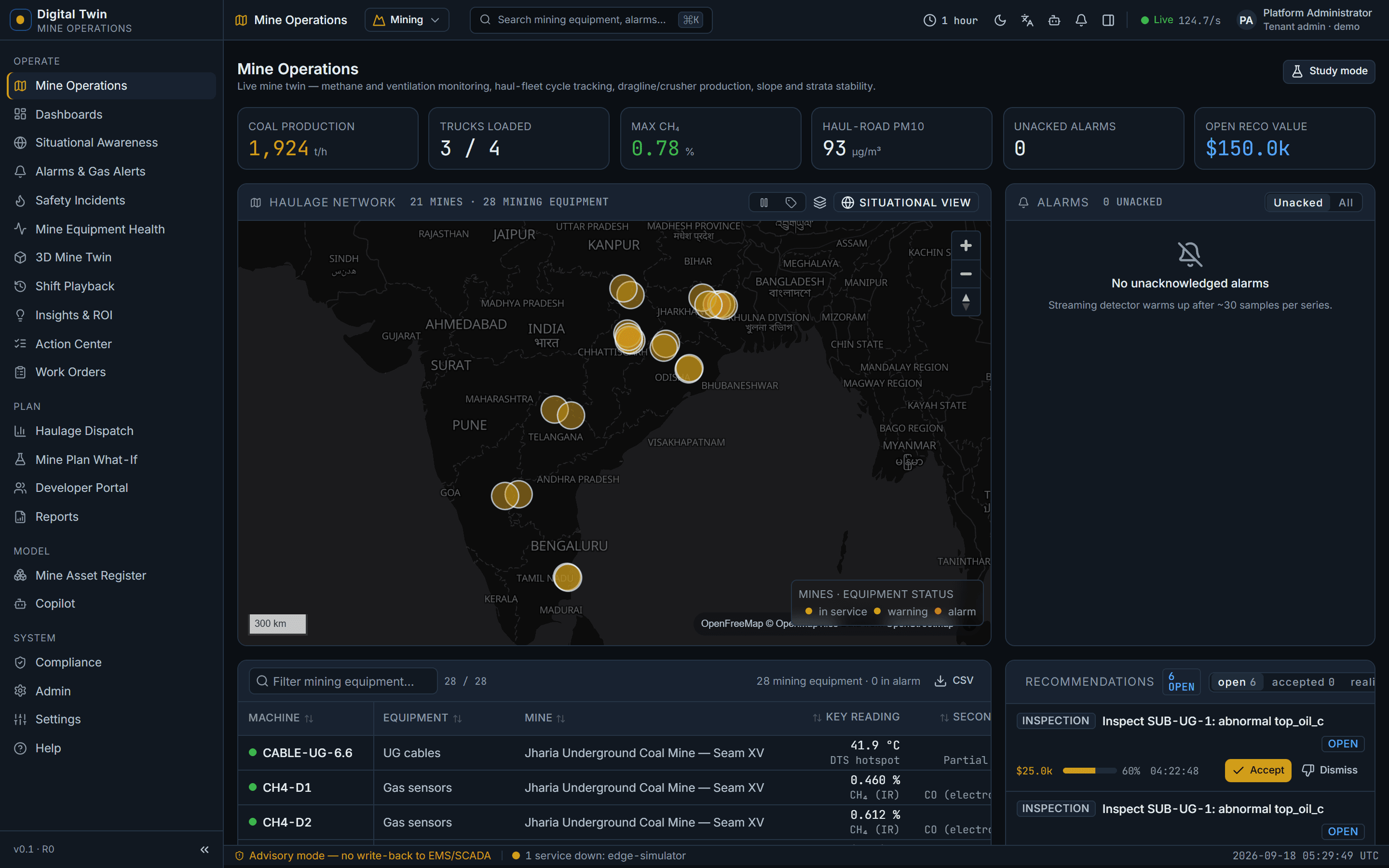
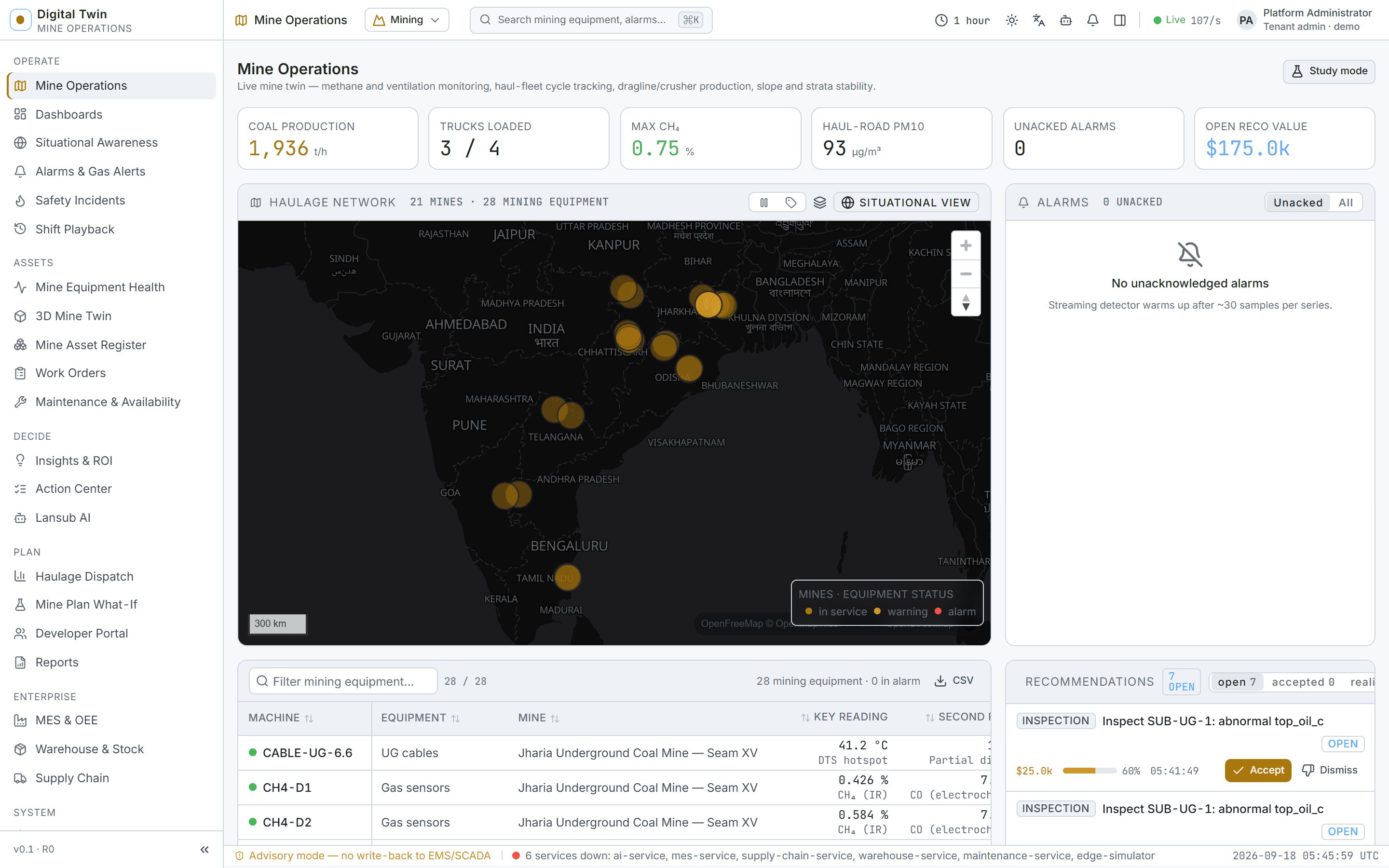 MiningOpen-cast and underground coal / mineral operators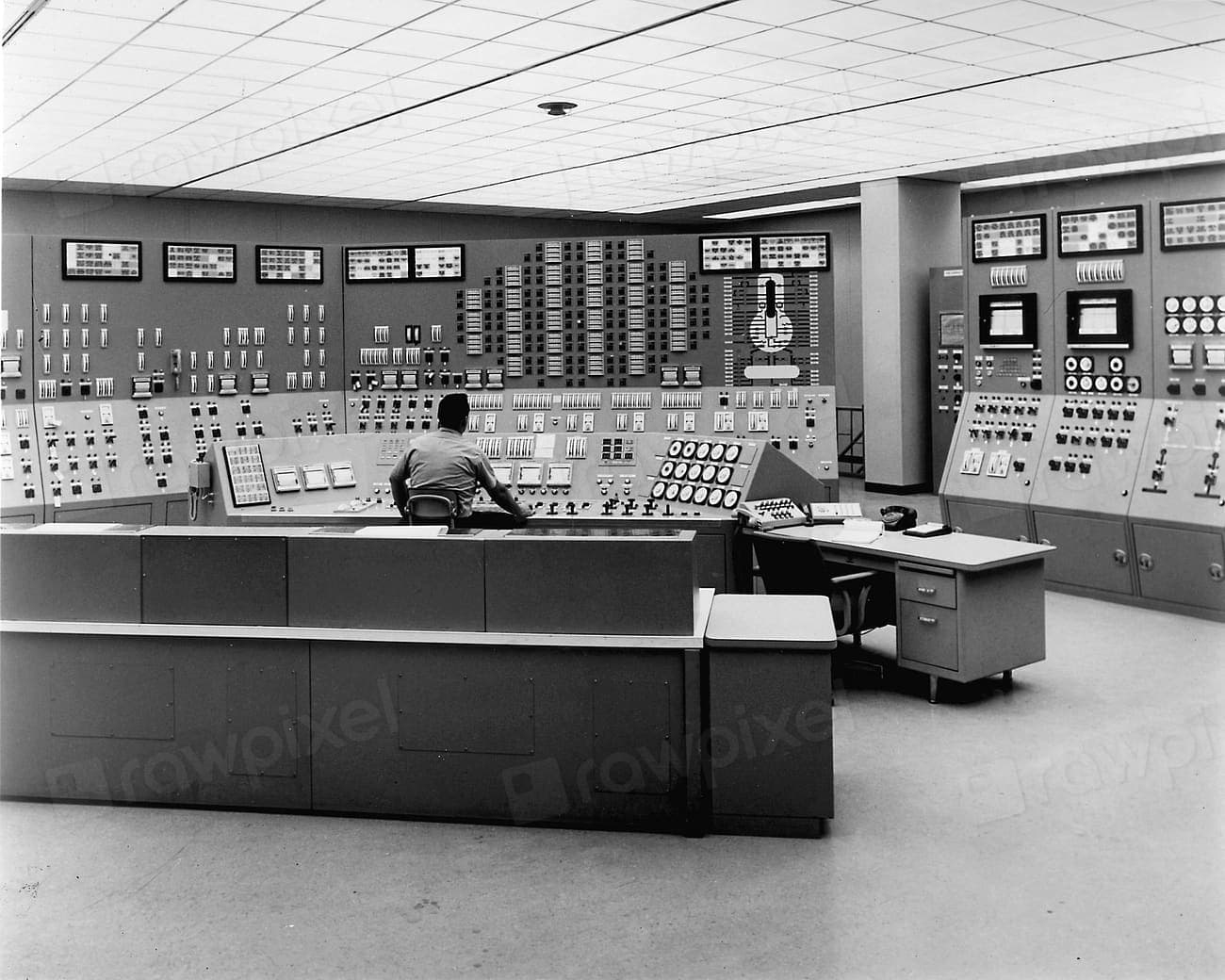
Built for the control room
Built for the people running the grid tonight.
Digital Twin puts physics-backed limits, live health and the next defensible action on the screens your operators already watch. No new control room, no parallel process.
Why Digital Twin
Built for operators who need results this budget cycle, not a five-year transformation.
OEM-neutral, open ontology
CIM/CGMES-aligned twin model and open, versioned data contracts. Your models are not locked to one vendor's APM.
Physics you can audit
Every rating, health index and recommendation cites the standard and the inputs it was computed from.
Outcome-tracked
Recommendations carry expected MW and USD; realised value is recorded in the ledger so ROI is measured, not asserted.
Your perimeter
Microsoft Azure in your region, your own subscription, or on-premises / air-gapped. The same platform, the same installers.
See Digital Twin on your own network data.
A 45-minute working session with our grid engineers on a sanitised slice of your topology and telemetry, followed by a scoped 90-day pilot proposal.
References for figures on this page
- IEA grid investment outlook (via IBM Institute for Business Value).
- GE Vernova — software-only dynamic line ratings: up to 33% additional capacity; significantly lower cost than sensor-based DLR.
- IJEPES — UK dynamic line rating demonstrator, ≈ 56% curtailment reduction.
- GE Digital Wind Farm — 25% less downtime, up to 5-year life extension.
- DOE iQMS / Lawrence Berkeley National Laboratory — interconnection queue statistics.
- Verified Market Reports — energy & utilities digital-twin market USD 9 B → 36.9 B (19.7% CAGR).
- IEEE Std 738-2012, IEEE Std C57.91-2011, IEC 61400-12, IEC 61724, ISO 10816-3, IEC 62271, IEEE 1547.